A bass angler’s winter

It’s that time of year again

It’s funny how we bass anglers seem to fall into the same, reassuringly familiar, pattern over the year. This is mostly dictated by fishing and the weather. At this time of year, the winter weather is playing havoc with our seas, and the bass are (mostly) off spawning.

January catches

My catches for January were poor. This is not unusual at this time of year in Cornwall, once we get past the period immediately after new year, which I missed this year as I was spending time with family in Guernsey. Mind you, I did hear of a few fish being caught in Cornwall – Steve Richards’ son Dan was catching nice fish until well into the month, like this one on 24th January:

A nice bass, just shy of 8lb, for Dan Richards – caught on a Fiiish Crazy Eel Offshore 20g jighead/Savage Gear Sandeel 10cm tail combo.

And one of my Guernsey pals, Simon De La Mare, has done well this winter, and was catching throughout the whole of January, with 5 bass in the 4-5lb range during this time.

Simon De La Mare with a fat 66cm Guernsey bass, caught in late December on a white DoLive.

Time for a winter break?

So for most of us it’s time to scale back on the fishing, but we can’t let go completely. With spring just around the corner, it’s time to start thinking about what  the year ahead might bring, and what new methods, marks, lures, equipment, clothing, footwear etc might increase our enjoyment of our fishing, and our chances of success.

It’s also a time for checking gear, and stocking up on supplies. Don’t forget your local tackle shops, like the excellent Lowen Chy Angling in St Austell, Gwinear Angling near Newquay and Art of Fishing in Wadebridge. If you can’t find what you want, you’ll need to go elsewhere, and as a BASS member,  you’ll be entitled to a discount from a range of tackle suppliers and guides.

New toys

Anybody who has read my book A Bass Angler’s Life’  will know that I can hardly be described as a ‘tackle tart’, but I do like to try new lures out. So when Steve Richards told me about one called a Dark Sleeper I was intrigued, particularly when he sent me this link to an incredible bass fishing video where two French anglers are catching some big bass on it.  This is a beautifully made film, and I thoroughly enjoyed watching it. Naturally I just had to get one of these things myself. As the film says, because the lead is internal, and the attachment is at the top, they can be trundled along the bottom, where these goby imitations should attract any bass lurking among the weed and boulders. I’m looking forward to giving it a try at the first opportunity I get!

Steve also sent me a link to a new type of surface plug, the Autowalker 115s. I don’t like too much fuss when I’m lure fishing, so this lure, which imparts a walk-the-dog action with just a simple straight retrieve, suits me down to the ground.  I’ve already taken delivery of one I obtained from here. 

Not another hotspot!

Even though I’ve fished at many, many marks over the years, there’s always somewhere new I want to try. This year is no exception, and I’ve already sussed out a couple of places which I’ve either been told about, or I just fancy the look of.  It’s important to get the feel of the place, find out what the ground is like, where to park etc., so that when you do eventually fish it you don’t waste any time.

Where did all the sand go?

One of the effects of the rough weather we get at this time of year is the way it can strip sand away from beaches, temporarily exposing rocks underneath. I noticed this at a couple of my local beaches recently. In one case I could see that the sand that had been removed from the top of the beach, exposing extensive rocky ledges, had been dumped near the low water mark. When I returned a couple  of weeks later, the beach had almost reverted to its previous state. In the other case, the sand appeared to have been moved down to the other end of the beach. Apparently this movement of sand is caused by a combination of waves striking the beach at an angle, causing the sand to be gradually pushed along the shore (longshore drift), strong tides and currents, and a lack of seaweed to stabilise the sandy bottom.

This lack of seaweed may be caused by a certain amount of ‘pruning’ as a result of being ripped up by the waves caused by autumnal/winter gales, and the fact that its growth is limited in the early months of the year. Have you noticed how the weed problems you would normally expect are less in winter?

What effect does this have on our fishing, apart from revealing rocks you never knew you’d been standing above? A favourite mark of mine fishes best when I can get onto sand for a couple of hours over low water. Last year all the sand was gone, which made the type of fishing I like to do there difficult, even on a big spring tide. When I did try to fish it, I blanked, probably because the sand had been piled up offshore, creating a bar just beyond casting range, keeping the fish outside until the flood was well underway.

I like fishing rough ground, but do these newly exposed areas on the beach fish as well as more established ones? Does it take time for the gobies etc to colonise these areas, and are they put off by the fact that the sand can reappear at any time?

A helping hand from nature?

The weather also affects fish behaviour. One aspect of this is the first winter survival of very young (or ‘0’ group) bass, and spawning success. As yet, we have not had a prolonged cold spell this winter, so the good numbers of ‘0’ groups we saw last year should hopefully survive well. Persistent winds from a westerly direction around the time of spawning help to push the tiny fry towards our coasts, and increase the chance that they will settle as juvenile bass in our estuaries and elsewhere. This leads to good year classes, providing good fishing in the future.

The winds in recent weeks have been mainly from the west or southwest, so hopefully this means we might be in for a good year class – assuming there are enough breeding fish left to produce the fry, that is. Let’s just hope we don’t get another ‘beast from the east’ like we saw in 2018, with strong east winds, which could have the opposite effect. Our juvenile bass surveys in the Fal and Helford rivers in Cornwall will resume in May, so these should give us an indication of both first winter survival of the 2019 class and, from August on, the strength of the 2020 class. Incidentally, if anybody would like to help with these surveys, please let me know.

Let them do their stuff

The spawning fish will hopefully be left to do their, very important, thing, with the prohibition of commercial bass fishing in February and March.  If you see bass for sale, and it isn’t farmed, report this to the MMO via this link.  Similarly, if you see ‘wild’ sea bass on a restaurant menu, ask if it’s fresh or frozen; if the former, again report it to the MMO. Recreational sea anglers can fish for bass during this period, but cannot keep one during February. While we can keep two fish (over 42cm) a day in March, I would suggest that you return any fish whose girth suggests they are still carrying eggs. Note: the bass fishing proposals are expected to be ratified at any time.

Thanks for reading my blog. Going forward, I will not be notifying people of each new post by separate means, so if you’d like to continue reading these, please subscribe to my blog via my website if you haven’t already. If you find the posts useful, it would be great if you could make others aware of them.

All the best and tight lines,

Robin


A new decade of bass angling

A time to reflect

It’s that time when we reflect on the year just finished, and look forward to the one just starting. Whether it’s about bass angling, or life in general, this is something I’ve always done. I guess it’s about the closing of one discrete chapter in your life, and the opening of another. Perhaps my Scots ancestry has some bearing on this; I love Hogmanay and a ‘wee dram’ of the rusty water!

This New Year is also the start of a new decade. So much has happened to me in the last ten years, both in my personal life and my fishing life, and I’ve no doubt that the next ten will be just as eventful. That’s assuming I’m fortunate enough to be around for that long! As you get older, you become increasingly conscious of your own mortality. This inevitably affects how you view your fishing – will I still be able to fish in 10 years’ time, and if so in what form? Should I try new things, with the risk of wasting precious time, or stick with what I know?

A book about bass angling

Easily the most momentous event of 2019 for me was the publication of my book ‘A bass angler’s life’ in July; I wrote about this in my first two blogs. They say that everyone has a book in them, and I’d certainly encourage people to have a go – I’m glad I did.  I’ve gained a great deal of satisfaction from just achieving one of my lifetime ambitions, and the comments I’ve received have made it all worthwhile; I’ve included a few of these in the book reviews section of this site.

Friendships forged

As I’ve said before, fishing isn’t just about the catching of fish – it’s about many other things, including the friendships you form through it. Last year saw old friendships renewed, current one strengthened, and new ones forged, and I count myself very fortunate to have such good friends. I won’t embarrass them by mentioning names, but they know who you are, and I thank them for their valued friendship.

A disappointing December

If you look through my picture gallery you will get an idea of some of my bass angling antics last year. The telling thing is that the last picture is from mid November. After that my catches pretty much died away,  just when I was expecting things to ramp up. The awful weather in November and December didn’t help the fishing, nor did the amount of gill netting that was going on. Family business took me away from Cornwall over Christmas and into the New Year – just when the conditions were getting interesting! I did have a lovely time over in Guernsey though, including the birth of my second granddaughter, who tipped the scales at 7lb 8oz – if only I’d caught a bass that size while I was out there! I did manage a few small bass on DoLives on New Years Day over there, so at least I’ve opened my account for 2020.

My first bass of the new decade.

Bass angling in 2019

Many anglers reported disappointing catches, consisting mainly of small fish. From a personal perspective, looking back on the year as a whole, I would say it was quite a good one. OK, I didn’t catch as many as I usually do (and some others did), and I still haven’t landed that double, but I did manage some nice fish. These included 12 over 60cm, amongst which were a 7lber and two 8’s.

I think the reason I caught fewer bass in 2019 may be in part down to the way I fished. Until November, I did a lot of lure fishing, mainly with  DoLives and plugs with single hooks. I’ve found that both these tend to result in fewer hook-ups from small bass. This is no bad thing in my mind, as this avoids any potential damage to these fish, and I’m mainly after the bigger ones anyway (like most folk I imagine) .

After November, I concentrated on bait fishing, mainly with big mackerel baits, which again seems to result in fewer small fish.

Bass catches in the past

We often speak of the ‘good old days’, when bass angling was so much better than today. You had only to stand on the beach with your split-cane rod and centre-pin reel, loaded with ‘cuttyhunk’ line, and the bass would leap onto your hook. But was it really like that?

The trouble is, there is such a lack of data for us to make an objective comparison. So when Richard Brandon sent me a link to a chapter in ‘The Art of angling’ called ‘Bass and bass fishing’ by esteemed author and angler-naturalist Donovan Kelley, I was intrigued to read his breakdown of the sizes of bass you could expect back in 1957.  Among a total of 400 fish, caught over a representative period, he records the following:  1.5-3lb: 56%; 3-5lb: 32%; 5-7lb: 8%; 7+lb :4%. My own catches in 2019 were split as follows: <3lb: 76%; 3-5lb: 12%, 5-7lb: 10%; 7+lb: 2%. It’s interesting to note that, even using the techniques I did, I caught a greater proportion of smaller fish, and fewer medium-sized fish, than in those days.However, my catches of larger fish made up a similar percentage to Don’s.

Other anglers in Cornwall reported bass around the 60cm (~5lb) mark in their catches, and it seemed that there were quite a few bass  of this size around. I think these are from a steadily growing (by around 5cm per year) class, possibly the good 2007 year class. Later in the year, there also seemed to be a reasonable showing of 70cm (~8lb) fish. If these fish are spared the net, we might have an increasing chance of catching a ‘double’ in a year or two’s time.

Looking forward

Looking forward to the coming year, I hope that my results, in terms of the number of 60cm+ bass I catch, continue to improve. I will come up with a plan to try to achieve this, incorporating new knowledge and experience from last year. I’ll  probably fish right through the year,  increasing as we go into summer and autumn. I’m going to concentrate on those techniques and areas likely to produce bigger bass.

Lure fishing will probably form the larger part of my bassing, using my favourite DoLive sticks, so effective for fishing over shallow, rough ground at night. I’m not forgetting surface and shallow-diving plugs though, especially during daylight hours. I will bait fish whenever this seems like a more effective option, particularly early and late in the year.

Fishing opportunities

At the EU Fishing Opportunities meeting last month we were expecting the usual stitch-up of anglers. What a pleasant surprise then, when our bag limit was increased for 2020. We have our colleagues in SOSB/BASS and the Angling Trust, and all those anglers who supported them with emails etc, to thank for this – it shows what can be done.

Come on CIFCA

I hate to finish on a negative note, but some may already know of the 75-100 immature bass which were found dumped in Hayle Harbour recently. These were probably caught in gill nets, with a mesh size which is too small to allow undersized bass to swim through, despite the minimum size having been increased to 42cm several years ago.

Cornwall IFCA  have done little to try to address this problem, so this needless slaughter of fish will continue. These are the brood stock of tomorrow, and desperately needed to replenish depleted stocks when capable of breeding. I applaud those commercial fishermen who have already changed their nets to those with a higher mesh size, and who abide by the current bass regulations. But there are those who still use the old nets, and cynically flout the law by targeting bass with them, ‘accidentally’ catching as many as they can, with the law powerless to stop them because of unenforceable regulations. And because they can discard their dead undersized fish at sea, usually nobody is any the wiser to the number of immature fish they are catching.  With the current size profile of bass stocks, they are probably throwing four back dead for every one they can keep, and yet they carry on doing so. If you feel as strongly about these issues as I do, please let your MP, Cornwall IFCA and your local media know what you think. We have a couple of strong year classes (2014 and 2019) coming through, so let’s give them the chance to at least reach maturity.

Who said bass fishing was easy!

Bloody weather!

Just when you think you’re having a great bass fishing year, you get brought down to earth by a whole list of things conspiring against you, over which you have no control.

The most obvious of these is the weather; we seem to have had one blow after another, creating big seas, and restricting when and where you can fish. And it seems to have rained for most of the month! Now, I’m not a fair weather fisherman, but standing in pouring rain for hours just doesn’t do it for me. So when I see those two little drops on the BBC Weather App, it’s feet up and watch the telly time for me.

Feeling the pressure

One aspect of the weather is atmospheric pressure. In November the pressure was low (below 1000 hPa) on 14/30 days, and the average was only 1001 for the month, significantly lower than previous Novembers. When the pressure is dropping you can get good fishing, but if it stays low it seems to put fish off feeding.  The other thing about low pressure is that the tide doesn’t go out as far as the tide table predicts. This can prevent marks being accessed safely over low tide, or mess up a bait collecting trip.

Estuary quest

The rough conditions have made me turn my attentions to the calmer estuaries for bass fishing more. I’m still in the information gathering, trial and error, lots of legwork phase. I’m looking for somewhere I can catch big bass, in calm conditions, and preferably during the day. Let’s hope my efforts pay off in the long run, but as yet, despite some promising leads, success still eludes me.

Slim pickings

Despite getting out whenever I can, catches have been poor for me in November. This is particularly frustrating, especially at a time when big bass are on the cards. Whether this is down me persisting with big fish baits, at the expense of lure fishing; to not having the conditions to fish the marks you know well; to the atmospheric pressure, or to changing migration patterns, I don’t know.  It’s worth checking out landings of fish at your local port to see what bass might be feeding on, or drawing them away from the shore. For example during the week ending 15.11.19, 1300 kgs of cuttle (‘black gold’ as they’re known) were landed at Newlyn. The only consolation is that most of my other mates in Cornwall haven’t done very well either. Some have though – Richard Brandon had his best month of the year, with 9 bass to 4lb+ on bait, and Simon De La Mare in Guernsey managed 77 bass, including 8 over 5lb  – all on lures. I’d be interested in any comments from other anglers about their bass catches in November.

The netters are out

But maybe there’s another explanation for the poor bass fishing I’ve seen this month – gill nets. It’s currently illegal to target bass with gill nets, yet we know this is widespread under the pretence of fishing for other species. Reports from anglers in other parts of Cornwall, and elsewhere, suggest that whole areas of the coast are, at times (like now), effectively closed off by gill nets. Not only does this damage bass stocks, still in a precarious position, it puts wildlife, such as seals, dolphins and birds,  at risk of slow and painful death. They also prevent commercial hook and line fishermen from earning a living, and prevent anglers from catching a bass – they can be set so close in at times that they are within range of even lures! A couple of recent trips serve to illustrate my concerns about nets.

At last some success

Despite fishing a lovely wind sea, perhaps a foot or two, and no weed, I wasn’t expecting much, in view of recent results.  After an hour with mackerel baits, it looked like my suspicions would be confirmed. Time for a change of bait, I thought, but should I stick with the fish theme, and try a Cornish sardine, or use one of those juicy crabs I collected from my traps last week? I opted for the safer option, and loaded the 6/0 Viking with a couple of shore peelers; they seemed to be peeling well mid-November, and I wondered if the bass would be in tune with this. I made a modest cast, just far enough to clear the odd rocks dotted about the sand, took up the slack, and waited……….

Contemplating the brooding Autumn night sky, a definite tug on the line brought me back to the here and now. A second tug was met with a swift sweep of the rod up and back, but there was no resistance. Interesting I thought, better check the bait. The dollop of crab had been pulled down, and a bare patch betrayed the attentions of a fish. Since the bait hadn’t been out long, I topped it up with another crab, and lashed the whole lot together with bait elastic.

No more than five minutes after casting out, I had another bite; but this was much bolder than the last, the type you hit instinctively – and hard. Yep, fish on, and putting up a good scrap, as I brought a pleasing 55cm bass through the surf.

Time to experiment?

With bass like this around, I just had to try a sardine. I’m all for experimenting, but after 20 minutes without a bite, I decided it was time to go back to crab. I loaded up with a couple of decent peelers (not cheap if you have to buy them, especially compared to sardines, but worth the money), and cast out to the junction of rocks and sand.

I didn’t have long to wait to see if the fish were still there – the rod slammed over, and this was met with an automatic strike. Yep, fish on, and kicking strongly, as I wound her in. She was putting up a lot of resistance, and I had to adjust my grip on the little multiplier handle to keep her coming. Slowly but surely, I brought her towards me, until she was there – a beautiful 61cm bass (5-8 weighed) laying on the sand. Not the big one I am looking for, but very satisfying, particularly after my recent bass drought (apologies for photo quality).

If only we’d known

A couple of nights later, I was back at the same mark, this time with my mate Steve Ainsworth. The tide had built from a neap low water, to a medium spring; the sea was a similar height, although more of a dying, erratic swell than a busy wind sea. Hopes were high, but despite two of us fishing for 3 1/2 hours, with a range of baits (crab, mackerel, squid, bluey, razor) we caught nothing – zilch, nada, diddly squat, blankety blank! Who knows why this happened, but to not even catch the odd fish, I reckon there must have been a net out in front of us. We were probably completely wasting our time; if only we’d known this before we started. So frustrating and disappointing!

An encounter with a feathered fisher

My efforts on the coast have not been without incident though. Take the night Paul Wallace, Richard Brandon and I were bait fishing with bass legend Alan Vaughan. Alan was just telling me how he holds his rod pointing down at the water, so that any bites are not absorbed by the bend of the rod, when I heard a loud squawking noise to my left. “What the f**k is that” , I said. “It’s a heron” said Paul,” it must have flown into my line!” Fortunately he managed to release our avian piscator friend, and all was well. I expect he blanked as well though!

An encounter with a whiskered fisher

On another occasion, I was changing lures when a hissing noise drew my attention to this, amazingly camouflaged, little fellow among the rocks:


As you can see, he wasn’t best pleased to see me, hissing and baring his teeth! He was a few yards up from the high water mark, and with the tide on the turn, I couldn’t see how he was going to make it back into the sea. I took my coat off, thinking I could pick him up and carry him down to the water.  I moved towards him, but he was having none of it, and I decided to leave well alone.

Call for help?

Anglers sometimes curse seals for scaring the fish off, but they are amazing creatures, and such an integral part of the marine environment. I felt bad that I hadn’t been able to help this one, reflecting that it would probably die; many pups do at this time of year – this is the harsh reality of nature I guess. But it played on my mind, and I called Dave Jarvis from British Divers Marine Life Rescue (BDMLR) in the morning. Yes, they can come out in the dark if needed and safe to do so; and yes, the fact that it was an inaccessible, unnamed beach, a mile or so from the road was not a problem.

After speaking to Dave, I decided to go back down to the beach, and if the seal was still there, to call out the BDMLR. But it was nowhere to be seen. Presumably the morning high tide, with the building sea, had allowed the stranded seal to get back in the water. How long it would have survived, if indeed it had lasted the night, I don’t know. At least I’ll be better prepared next time I see something like this.

A load of bullocks

On another occasion, I arrived at the field above the cliffs to find a herd of chunky-looking ‘cows’, instead of the usual cuddly sheep, huddled around the gate. “Bullocks!” I thought, I’m not letting them stop me going fishing. I took a deep breath, and gently opened the gate. The young fella leaning against it jumped back, which made all his mates do the same, rather unnervingly. I slowly, but purposefully, entered the field, not thinking about what I would do if they decided to turn nasty; you can’t let  such considerations affect your fishing now, can you?

As it turned out, the boys were fine,  and I made my way to the top of the cliff. I had worn my Rockhopper studded boots, anticipating a slippery descent after all the rain we’ve had. But I hadn’t anticipated that some helpful person would have cut the rope! Without this, the prospect of getting down the cliff was a daunting one, and getting back up even more so. I hesitated; was all this trying to tell me something? Bugger it, I’m not giving up now, I thought.

Slithering and sliding, I made my way down, with the odd brush with the nettles and brambles. But despite fishing for 2 1/2 hours over dusk and into darkness, with a selection of lures, in nice conditions, I only had 1 small fish on momentarily. Maybe I should have listened to my inner voice after all. On a happier note, I did manage to get back up the cliff, and the boys took no notice of me, even with my head torch on.

A fair deal for anglers

The annual EU Fishing Opportunities meeting is fast approaching. It’s vital that we make the case for a fair bass bag limit for anglers in 2020. Even if you feel passionately about Catch and Release, it’s important that you support this. Don’t inadvertently play into the commercials’ hands by allowing them to get higher catch limits at our expense, thereby damaging stocks when they are still far from safe.

Save Our Sea Bass have once again come up trumps, and produced a very professional, informative and helpful resource with which to make your feelings known to the fisheries officials very easily. Please visit their website and support this campaign.

And if anybody asks for your vote in the General Election, ask them what they’re going to do to ensure that anglers are given the proper recognition they deserve, and are allowed to play a meaningful role in shaping fisheries policies and management.

Join BASS

To make an ongoing contribution to the campaign for more and bigger bass, learn a lot about bass fishing, and get to know other bass anglers, why not treat yourself to a subscription to BASS for Christmas; it could be the best £25 you’ll spend all year!

Don’t give up on the bass just yet; depending on where you fish, there is still a chance of a good fish over the next 6 weeks or so. Let’s hope the weather doesn’t mess things up too much! Tight lines and I hope Santa brings you that big one for Christmas.

Please check out my gallery for more of what I’ve been getting up to this year.

Bass fishing this autumn

Peak time for that big bass?

I love bass fishing at this time of year, the season of ‘mists and mellow fruitfulness’. It feels like the air is pregnant with the prospect of a big bass, fattening up for winter,  snatching your bait or lure as you stand on some windswept shoreline.

It’s a time of flux too; the fish are on the move, and the usual fishing patterns change to reflect this. This can mean a pause, or possibly an end, to things, as the resident fish depart on their annual southwest migration. But as time goes on, depending on where you do your fishing, some of the best fishing of the year is on the cards, with the chances of big  (8lb+) bass at their highest, as the migrating fish from other areas make their way past our shores.

A mixed October for bass fishing.

My usual marks were oddly quiet last month. A good example of this was during the weekend of the, bass only, Cornish Lure Festival (CLF) on the 4th – 6th October. Despite fishing in good conditions, at normally reliable marks, the best I could manage was a fish of 46cm.

The CLF is run by the very helpful Ben Field, at the excellent Art of Fishing shop in Wadebridge. Despite storm (ex Hurricane) Lorenzo doing its best to spoil things, the event was a great success; 52 anglers registered, and some nice fish were caught, with 8 fish over 60cm registered. The winning fish measured 71cm and was caught by Ben Winter from Bristol. Devon angler Keir Simms was not far behind with a fish of 69.5. Local anglers Nick Topps and Roger Truscott  were hot on their heels, with fish of 68.5 and 68cm respectively, with Pete Williams catching the longest three fish with a combined total of 179cm.

But by moving around during the month,  I managed to find a few decent fish, like this 71cm (8lb weighed) bass, caught on a white DoLive Stick during Luke Kozak’s second visit to fish with me this autumn.

Conditions were fairly calm, and as I worked the lure with a slow-medium, steady, straight retrieve over the shallow rough ground, I felt that distinctive ‘knock’, which I knew was a fish, and not the lure bumping a rock. As I continued the retrieve, I felt solid resistance……so did the fish! It kited left and right, thrashing the water as it did so. “Don’t go over those rocks” I thought, using the rod to persuade it to go in the opposite direction. As I gained line, the next problem was where to bring her ashore. The gulley to my right would have been easier, but was a little narrow, so I opted for the one on my left, even though this meant bringing her across the front of the flat, low rock I was standing on. Safely ashore, I took stock of this thing of beauty I’d just landed, and spontaneously blurted out “Luke, I think I’ve hit the f***ing jackpot!”, before I quickly realised that I hadn’t landed my first double.

A return visit to the same mark the following night produced just the odd schoolie, and it looked like the netters had been in. This is an ongoing problem for anglers in Cornwall, despite the fact that bass cannot legally be targeted with gillnets. The other problem this month has been the weather, with a succession of wet and windy spells making fishing challenging at times, and affecting when and where we can fish.

Increasing your fishing options.

This has prompted me to look at estuary marks, since they escape the big seas we see on the coasts, and by moving around, you can get out of most winds. With the abundance of easily available food in such places, you wonder why big old bass would choose to battle the waves on the coast, rather than forage for crabs, worm, shellfish, prawns etc. in such quiet backwaters with relative ease. Perhaps they move between the two, at certain times of the year, or in particularly heavy weather. Or maybe it’s a bit like humans, who exploit a range of habitats, from gentler climes to those of a harsher, more physically demanding nature; the fish choose to return to the same familiar summer feeding grounds each year, wherever they may be.

Meeting the bass challenge.

Estuary fishing is popular in Ireland, and the potential for catching big bass in these is beginning to be appreciated in Cornwall too. This is as a result of some very good fish being caught by a mixture of targeted fishing, for example with lures, and while fishing for  other species such as gilthead bream and flounders. The problem is that, for me, it’s like starting bass fishing all over again, looking for new marks. I have never paid much attention to estuaries, which I always regarded as producing only small fish, and focussed my efforts on the coast. But that’s fishing for you – continually challenging what we know and do, and I’m determined to meet this one final challenge.

In my last post, I referred to my quest to catch a big bass on mackerel bait this autumn/winter.  I’m grateful to anglers like James Batty,  and to Clive Hodges on the BASS Forum (access to this comes with membership) for their advice and tips on using and presenting mackerel bait for bass. I’m pleased to report some progress on that front, with the capture of a 64cm fish (5lb 3oz weighed) recently.

Not a monster, but a respectable start I thought. You can just about make out the remains of the 4″ long tail-end of the joey mackerel I used for bait in the photo above. After a couple of hours standing on the beach, without a bite,  I found a handy rock to sit on. I was holding the rod, contemplating heading for the hills, when the tension on the line suddenly went. Instinctively, I knew a fish had picked up the bait, and was swimming towards me. I wound in as quick as I could until I could feel the weight of the fish, but not for long, as the fish kept coming at me. After more furious winding, I felt the weight again, and then managed to beach the fish, through the small, breaking surf. Had I not been holding my rod (which I always do), I probably wouldn’t have known anything about this, the fish swimming around until the hook came out of its mouth. To land my first bass on mackerel, and a half-decent one at that, was brilliant. It’s given me an unshakeable confidence in this bait now, and this will undoubtedly increase my determination to stick with it, and maybe even catch that lunker on it.

Planning for that fish of a lifetime

As I write this, we’re entering what is, for me, the best time of the year for big bass. So, during some of the bad-weather days we’ve had recently, I’ve been doing a little planning. I’ve looked back through my catch records for places which have produced 8lb+ fish at this time of year, and will target these when the weather and tides are suitable. Fishing at this time of year can be tough, and big bass don’t come easily (unless you get lucky), so as well as knowing where the fish might be, you need to be determined and focussed, and put the time in. Let’s hope these efforts pay off, and I’ve got something to report in my next post.

Short days, long nights

For those who like bass fishing after dark, the shortening days of autumn bring increasing opportunities to fish our favourite places. Those marks which fish over a neap low water, or a big spring high, can now be fished during the late afternoon/early evening in complete darkness, if work or other commitments allow. And for those who like fishing at first light, you don’t have to get up at silly o’clock at this time of year; Mike Ladle reckons to get fish on lures as soon as he can see the lure ‘splash down’, so I’ve started timing my arrival to coincide with this if I’m fishing early morning sessions.

Saving our bass

We’re approaching the December EU Fishing Opportunities meeting, where all the member states get together, and indulge in a bit of serious horse trading over what can be caught in the following year. It’s supposed to be about responsible fisheries management, but it usually ends up being an exercise in keeping the commercials happy, usually at the expense of anglers, while paying lip service to the scientists’ advice about what the  bass stocks can sustain. Keep an eye on the Save Our Sea Bass website for details of how you can help with any campaigns they may run as the meeting approaches.

For more information on what I’ve been up to this year, check out my picture gallery.

My book about bass fishing – 100 up!

A milestone

A little under 3 months since my book about bass fishing, ‘A Bass Angler’s Life’, was released, I’ve just sold the 100th copy. This is something of a milestone for me, so I hope you’ll forgive a little celebration and reflection. Of course, this wouldn’t have been possible without all those who have bought the book, so a heartfelt thanks to them.

I thoroughly enjoyed writing the book, but as the prospect of publication drew near, I began to have doubts about how the world would judge my efforts. I was tempted to just file the manuscript away, to reflect on from time to time, and not risk the book being ridiculed, or treated with indifference. But my aim was always to get a book published, so I just had to be brave, and hope for the best.

All that’s behind me now, and I can honestly say I’m glad I went ahead. Sure, 100 copies sold is small fry to some, and I have a long way to go before I cover my costs, but to me this represents a success. I still can’t quite believe that so many people have  bought my book. I’ve also had some very encouraging feedback and comments, via phone calls, emails and social media, including the BASS Forum (access to this comes with membership). I’ve listed some of these comments (with permission) on this website (see under book reviews).  What I hadn’t anticipated is the way the book would bring me into contact with so many people.

A busy summer

The summer hasn’t all been about the book though. If you have a look at my picture gallery you’ll get a flavour of what I’ve been up to. Fishing wise, this is turning out to be one of my best years ever. I’ve caught 9 bass over 60cm (roughy 5lb), the first one on the 5th January.  The best of these, which measured 71cm (8lb 1oz weighed), came a couple of weeks ago. Seven of these fish came on  DoLive Sticks, the other two on peeler crab (shore). Hopefully, the best is yet to come, as long as the weather (and the netters) don’t mess things up too much! Mind you, when conditions get tough, it forces you to consider other options, thereby expanding your fishing repertoire.

7lb 4oz. DoLive Stick (Wagasaki). Guernsey. 5.7.19 (early morning).

Hope for the future?

July saw quite a few small bass around in Cornwall, and this seems to have continued through to the autumn. Without doing scale analysis, I would think these are from the good 2014 year class, and very encouraging to see. Let’s hope these little fish are allowed to become big fish, and give us a chance of a lunker in years to come. And from the juvenile bass surveys we’ve been doing over the summer,  it looks like 2019 could be another good year; just as well, given the very poor results we saw last year.

Away from home

Mid August saw Angela and I heading over to Guernsey for an extended summer holiday. It was great to spend time with family and friends over there. We were fortunate with the weather, allowing us to enjoy the wonderful coastline and beaches, and sample more of Guernsey life and the many events the island puts on. The fishing wasn’t spectacular, it has to be said, but it was great to meet up and get out with Bryn, Simon and the other lads again. We fished quite a bit, particularly over the GBASS Festival weekend, and it was good to try new marks and techniques, such as very slowly retrieving free-lined live launce, a popular method on the island.

Just days after returning from Guernsey, I was off again, this time to South Devon for the BASS South Hams Fish-in.

This is a beautiful part of the world, and it was great to spend a few days exploring the area, while meeting up and fishing with the guys from BASS, including exchanging a few fishy stories over a pint in the legendary ‘Pig’s Nose’.

Mike Killick at the South Hams Fish-in

One particularly memorable part of the fish-in for me was getting to meet, and fish with Alan Vaughan. As many will know, Alan co-wrote ‘Hooked On Bass‘ with Mike Ladle. Like Mike, Alan was very helpful when I was writing my own book. After numerous telephone conversations and emails, it was great to finally meet up. Seeing Alan baiting up with corkwing wrasse had me thinking back to the book, which so affected my fishing all those years ago. And watching him working the legendary ‘Chug Bug’ surface lure, which has accounted for numerous fish for Alan and many others, has got me rifling through my tackle draws in the garage to give them another go.

Cornwall’s firing!

The dust had hardly settled from the Fish-in, when Luke Kozak joined me for a successful, and very enjoyable few days’ bass fishing in Cornwall. It seemed like ages since I had done any fishing at home, and this spell reminded me how good the fishing  in Kernow can be.

We were into fish from the word go, with Luke doing well on surface lures. The night before the Duo Bassmasters Lure Festival, I landed a 71cm fish, along with another of 55cm, both on DoLives (white).  On the first night of the festival, I landed a fish of 62cm (again on a DoLive), before the wind got up and spoiled things. On the Sunday morning/lunchtime, what was expected to be just a ‘filler’ session, before heading up to Launceston for the prize giving, turned out to be a real bonus. We landed ten bass between us, with Luke catching some nice fish on a Sasuke 140 plug (Sand Bora).

That’s the thing about competitions – they make you go fishing when you wouldn’t normally bother, sometimes with surprising results. If the fish are there and feeding, you can catch – even in bright conditions, in the middle of the day. Mind you, a bit of surf definitely helps. Luke ended up with the visitor’s prize and just missed out on the longest 3 fish.

I’m very much looking forward to a sustained period of fishing from now until the end of January. One of my objectives is to catch a big bass on mackerel bait – let’s hope I have something to report by then! Tight lines to you all, and here’s hoping you achieve that new Personal Best.

Welcome to my blog

The book!

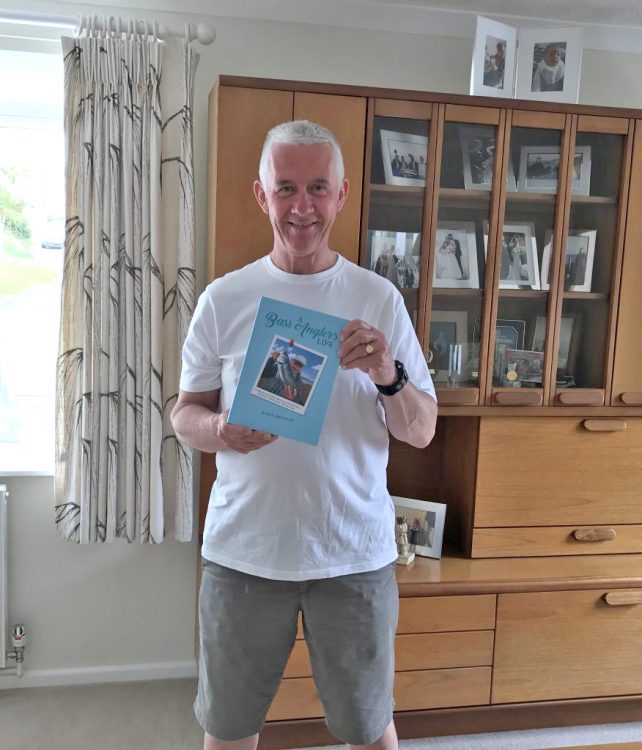
Well here it is folks. 6 years, and many moons after I started it, my book ‘ A Bass Angler’s Life’ is finally a reality, and represents a long-time ambition achieved. I’ve always enjoyed writing, particularly about fishing, and this has been a real ‘labour of love’ as they say. My writing has been mostly via BASS, in its quarterly journal and elsewhere, but I always had a hankering to write a book of my own.

When I retired at the end of 2012, the project began with a rough plan of the things I wanted to include. At first it was just something to do in the winter months, when I wasn’t fishing. As time went on, I realised that I needed to pull my finger out, and actually get something published. I nearly went for it last summer, but the ‘project’ was in danger of eating into my fishing time, something which cannot be allowed (unless it’s a question of life or death!), so I decided to finish it off during the winter/spring just gone; I also hoped this might give me another season to bag that double, but alas that wasn’t to be!

‘A Bass Angler’s Life’ hot off the press!

I thought I’d missed the boat when, after what seemed like ages since a book on bass fishing was published, two came out in short succession last Autumn. But I needn’t have worried, for although James Batty’s ‘The song of the solitary bass fisher’ and Marc Cowling’s ‘The lure of the bass’ are both excellent books, mine offers the reader a slightly different take on the world of bass angling, one which I hope will appeal to all who enjoy the wider aspects of this wonderful pastime, and how this relates to our family and working life, something we all have to juggle with at times. My life as a bass angler has been rich and varied, and taken me down many different paths; I have tried to share the breadth of experience this has given me in the book.

The blog will be a continuation of the book. I aim to post blogs, covering fishing, bass science, bass conservation/management, and anything else related to bass fishing, on a fairly regular basis, depending on what’s happening, so please have a look when you can.

You’ll find some information about the book in the early pages via the taster link, but I thought a short summary of each chapter might help:

Chapter 1
How I got into bass fishing, and how my fishing style has broadened over time. Balancing fishing activities with family life.

Chapter 2
The people who have inspired and fished with me.

Chapter 3
The way I fish – with bait (includes collecting and storing bait), and with lures.

Chapter 4
The factors which influence when and where I go fishing, including types of marks, time of day and year, tides, winds, sea conditions, atmospheric pressure.

Chapter 5
Some of my favourite places in Cornwall. Discovering and fishing new marks and areas.

Chapter 6
Learning about bass fishing.

Chapter 7
The ways in which fishing affects and enriches our lives and brings us into contact with the natural world as a whole.

Chapter 8
Fishing mishaps, interesting occurrences, amusing situations.

Chapter 9
Some good fishing days, including notable catches, achievements, discoveries and fond memories.

“Tight lines” as they say, and thank-you for your interest.