I’ve long had a passion for bass angling. I’ve also had a lifelong interest in marine biology. My role as Science Lead for the Bass Anglers Sportfishing Society brings these two things together, and I’m delighted that BASS has been asked by Essex University to partner them on this very important research project.
This is a great opportunity for anglers to get involved in research which will fill some of the gaps in our knowledge of the life history of bass, thereby helping to restore stocks and maintain them in the future.
You can find more information here. Please support this project, either by keeping bass heads or forwarding the link to this blog to friends and contacts, or both.
It was with some trepidation that I published my book about bass fishing, A Bass Angler’s Life, in 2019. Would it be well received ? Would anybody buy it? Would I cover my costs? It was very much a labour of love, and whatever happened I had thoroughly enjoyed writing it – a lifelong ambition.
Well, four years, over 300 sales and numerous reviews later I’m glad I took the plunge. The latest of these reviews, from Cornwall Adventures, just blew me away when I read it. The author captures exactly what I hoped to convey in the book.
Is anybody else getting that special feeling when summer arrives, and the bass fishing starts really picking up? Late nights and sunny afternoons – they’re part and parcel of my fishing at this time of year, evoking many happy memories of sessions in years gone by.
With the sea temperature nudging 14°C and rising around Cornwall, things are also warming up on the fishing front. My own fishing has seen a definite upturn this week, and I’m hearing regular reports of bass being caught by others, so it’s a good time to get the gear out if you haven’t already started. Right on cue too – just look at the foxgloves coming out.
When the foxgloves come out it’s time to go bass fishing.
Hope for the future?
I’m also hearing reports of big shoals of bass around the 30cm mark. These are probably from the good 2019 year class; when I say good, it bears no comparison to some of the great classes of the past (1959, 1976, 1989). These four year-olds will be leaving their native nursery areas to begin the free-ranging adolescent phase, when they adopt the area they will return to every summer for feeding.
The other night there were plenty of little bass taking surface lures. From the length (25cm) I guessed they were either two or three year-olds, and some scales I took appeared to show they were just starting their third year, so spawned in 2021 – a reasonable class according to our surveys. They may not have been the bigger fish we are after, but at least it gives us hope for the future. Let’s hope that lots of these survive both natural predation and man-made activities; at this size they should escape the nets and any caught on rod and line can be returned.
Favourite surface lure
It was great to catch these fish on surface lures, the little (9cm) Arms Pencil (about 1/3 of their length!) doing the business. This is my all-time favourite surface lure. Like all good things, they’ve stopped making them – although you might be lucky if you search online under Silver Dog 90. Mind you, there are lots of similar ones now available, like this IMA Pugachev Cobra.
With all my plugs I replace the trebles with singles. In this case I was using barbed size 1 VMC 7237’s, with my usual ‘walk the frog’ technique (see this earlier blog). Even though the size 1 hook is small, it looks quite big in the mouth of a two year-old bass, and I was having a bit of trouble extracting it from some of the fish. I don’t like damaging fish any more than necessary, so the barbs have now been flattened on these.
Yozuri Arms Pencil – with single hooks fitted and barbs now crushed.
Check out this great short video giving tips on handling striped bass for catch and release; I’m sure this relates just as much to the bass we catch in the UK. I am indebted to my BASS colleagues for posting this on the online members forum.
Veterans
A recent session with fellow veteran angler/old scrote Steve Ainsworth saw us scaling the cliffs in a very age-inappropriate way. We were returning to an old favourite haunt that has been good to both of us in the past. ‘Must be over thirty years since we first fished this mark’ said Steve. I’m not one to accept limitations, but the fact remains that we’re not getting any younger. The tricky rope descent, and sketchy walk across the slippery reef seemed harder since the last time we did it; sadly I think this may have been our last visit to this special place. At least we have some wonderful memories of bass fishing at its finest to treasure. Don’t bring the Zimmer frame out just yet though!
As to the fishing on the night – they hadn’t read the script. Just one fish between us – to me as luck would have it – a rather nice, but not exceptional for this mark, 60cm bass on crab (alas no photo).
Soft plastic success
Another session produced some success on soft plastics. I was using a 5″ Easy Shiner and before long felt a pluck on the line, then another. Next instant – wallop! as a 54cm bass took off with the lure. This was followed by another of 41cm ( I measure all my fish for the BASS Catch Recording scheme). Curiously the next contact, a good bang which nearly took the rod out of my hands, didn’t connect. It was only when I checked the lure for weed a few casts later, that I realised the paddle tail had been bitten off!
Keitech 5″ Easy Shiner (Wagasaki colour) minus paddle tail, with new one below for comparison.
With my only Easy Shiner out of action it was time to try that one that the nice folks at Bass Lures UK had given me to try – two bass to 48cm later I was convinced!
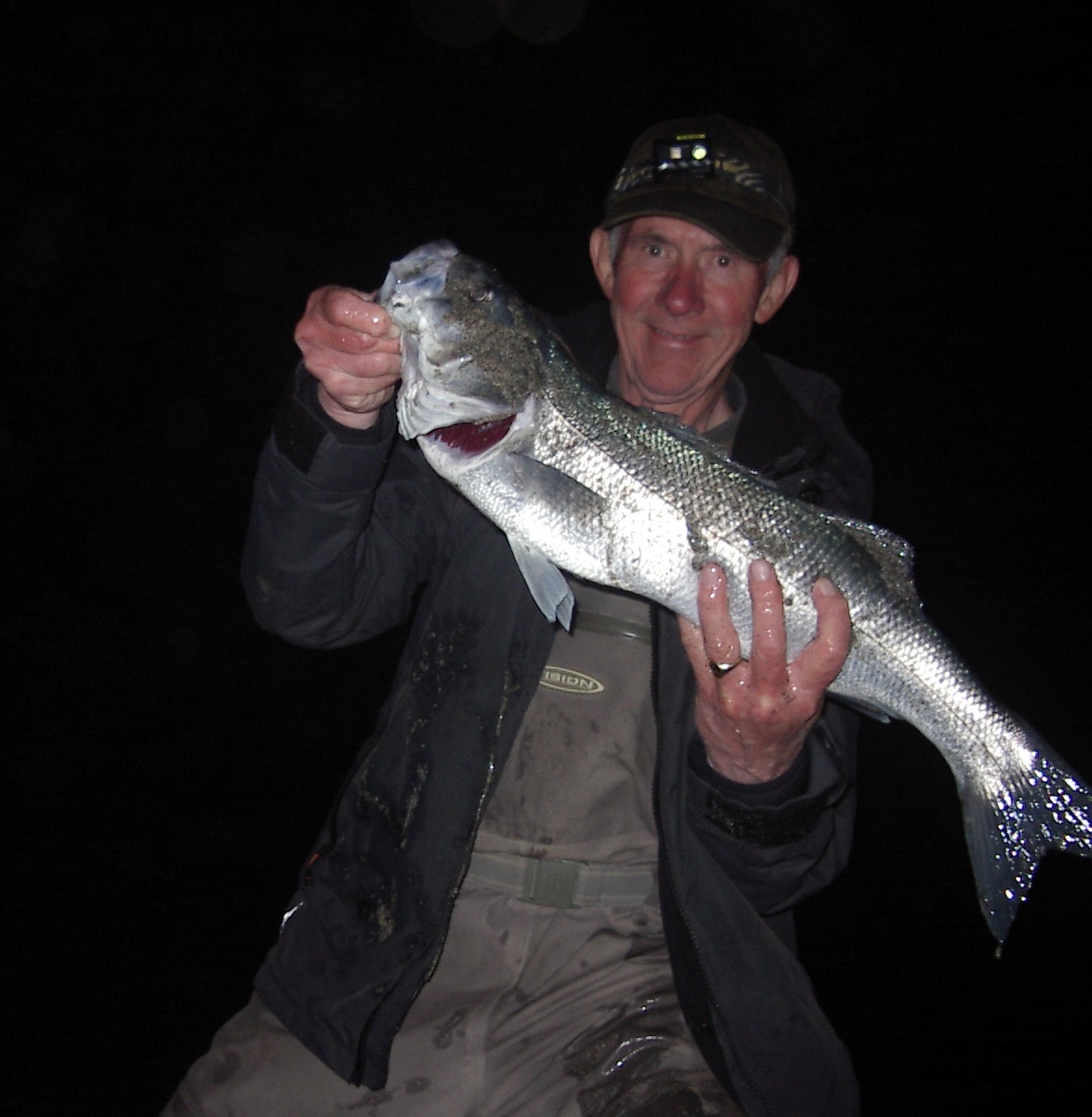
A return to the same venue the next night was oddly quiet. Apart from a slightly brighter moon, everything was similar. I cycled through a range of different soft plastic lure types and colours, including the Easy Shiner, to no avail. It was only when I put on the T – Tail from Bass Lures UK, which worked the previous night, that I had any action. The 50cm bass you can see in the featured image (and another of 49cm) were the result. Was it the speckles picking up the moonlight? Matt from Bass Lures UK certainly thinks so. Another interesting observation was the ‘mayweed’ clinging to the line and clip. It was only a small bit, but I had always thought than any weed on the line or lure killed its action. Scales I took from this first fish showed that it was just starting its 9th growth year – so from the good 2014 year class, which dominated catches last year.
Juvenile bass surveys
Speaking of year-classes, 2022 doesn’t look great. We found very few of last year’s fish (this year’s won’t have arrived yet) in our juvenile bass surveys on the Fal and Helford recently. This supports our initial assessment of ‘poor’ for the 2022 class. That’s the problem with bass recruitment – good years can be offset with bad.
A one-year old bass or ‘1’ group. We’ve found very few of these in our surveys so far this year.
That’s it for this month folks – thanks for reading.
After the winter break even Archie’s looking forward to going bass fishing regularly again. The jobs have all been done, the gear’s all been checked and topped up/replaced, and I’ve even got a new reel (Shimano Vanford C3000 – thanks for the recommendations Tony and Ben) to go with the rod I acquired last year (8’2″ Tailwalk Dageki 3.5-24g) . This combo is a treat to use in estuaries, and the shorter rod length will be useful when casting up against the trees at high water.
Among my Spring purchases were these beauties , my most consistent lure last year, from Cornwall-based Bass Lures UK. They do a wide range of lures and give great value for money.
First choice on the menu
I decided that I’d target the bass with crab early on in estuaries this year in anticipation of some good fish searching them out. This seems to be working so far – three trips in and I haven’t blanked yet. No monsters mind, but peelers do seem to be first choice on the menu, with just the one fish on soft plastics. I suppose that makes sense, given the amount of peelers usually around at that time – not that my traps are producing that well yet. Bass can find any amount of small hardbacks throughout the year, but it’s the Spring peel which seems to coincide with the arrival of the bigger fish.
Focus
I caught fish on 41% of the trips I made last year. One of my targets for this year is to try to improve on this (that’s if the fish are there to catch), so my plan is to focus more on a smaller number of proven marks at the peak times, in good conditions, and using lures and methods I’m confident with. I really want to try to gauge just how bad (or good) the stocks are, and if I don’t catch, it’s more likely to be that the fish aren’t there, rather than me not fishing it properly.
As I get older, I’m beginning to appreciate the benefits of fishing closer to home, at places I’m familiar with, and enjoy being at – even if it means reducing the chances of catching bigger fish.
Tight Lines
I attended the Tight Lines meeting this week. What a great venture this is! There was an interesting talk from a couple of GP Practice staff about Social Prescribing. For those not familiar with this, it’s basically about signposting people who may be struggling with their mental health to groups like Tight Lines as part of their recovery.
We also heard from a couple of guys from the Porthleven Coastguard team. So good to meet the folks who provide this great service – on a voluntary basis. Reassuring to know that such folks are ready to come to our aid, should we need it, but let’s do all we can to avoid this by taking well-known basic precautions.
Award
At the recent BASS AGM I was presented with the John Leballaur Restoration Award in recognition of our juvenile bass survey work in Cornwall, and my Science work for the society.
This award is greatly appreciated and valued, particularly given the esteem in which I held the man himself. I wrote this in my book back in 2019:
“In 2000 and 2001, we were involved in a tagging programme with CEFAS. We were trying to build on the earlier work of Donovan Kelley and others in unravelling the movements of bass. The late John Leballeur, then Chairman of BASS, organised teams of taggers from around the Country. John was a genuinely decent man – patient, kind and helpful, and he inspired many people with his dedication to the restoration of bass stocks. The ‘John Leballeur Restoration Award’ for the individual, group or organisation which has made a major contribution to bass restoration in any given year, is a fitting tribute to his memory.”
Juvenile bass surveys
Speaking of juvenile bass surveys, we are just about to start this year’s programme. It’s always exciting anticipating what we’ll find. I’ve been keeping a watchful eye on the temperature and wind, as this can affect the success of spawning. I’ve learned not to be drawn into making any premature predictions, but I’ll keep you posted as and when things become clear. We’re always looking for more volunteers, so just send me a message if you’d like to help.
That’s one of the concepts behind the recently completed Fish Intel project, summarised in this press release . This short video shares the thoughts of some of the key personnel involved.
Bass, as shown above (Image: Keith Hiscock), are one of the species being studied by scientists from the UK, France and Belgium. I, and other members of BASS, have followed the project with interest since it’s start in 2021, and I was keen to hear all about it at the conference held at Plymouth University on the 2nd March.
There are gaps in our knowledge and understanding of the movements and habitat preferences of bass at different stages in their lifecycle, and projects like these aim to add to this knowledge. In this way, areas and stages in their lives when they are especially vulnerable can be identified. This in turn can lead to ‘smarter’ ecosystem based fisheries management which takes these things into account. Not only this, but other things like the interaction of fishing methods with other species, such as dolphins and seals, and the abundance of prey species that support bass.
Inspiring
I found the presentations enjoyable, informative and inspiring in equal measures. The main findings of the project are currently being written up, but researchers have already discovered that some seabass travel from the south coast of Devon to the coasts of Belgium over the space of a number of months.
We seem to have grown accustomed to ‘virtual’ or online events, but it was nice to be able to attend in-person again, especially in the presence of such eminent authorities in their field. It was a great opportunity to meet the people involved in the project and other stakeholders.
This project used tags which simply record the release and recapture site (where this is available), and not the journey in between. Being able to track fish implanted with sound-emitting acoustic tags using a network of receivers as they move around, gives much more comprehensive information. This network will remain in place, even though the project has closed, thereby continuing to record the movements of fish which have been tagged. The network is expanding too, enabling movements over an even wider scale to be picked up, and the network is being shared by scientists working on other species and projects using similar types of tagging systems.
An acoustic tag and receiver set-up as used in the Fish Intel project.
Happy place
As I arrived for the conference at the Marine Station at Plymouth University, it felt like I had reached my happy place. I was immediately transported back in time to Bangor University, where I attended a vacation course in marine biology as a youth in the late sixties. All these years later, I can still remember the field trips towing for plankton, and looking for seaweed in the Menai Strait. I was truly inspired by this, but at the time employment opportunities in this field seemed limited, and life took me in another direction.
My love of the sea started when my father’s RAF career took us to Malta. Daily visits to the beach, swimming and snorkelling in the mediterranean, somehow embedded the sea in my psyche. But it wasn’t until I got a job in the Haematology and Blood Transfusion Lab at the Royal Cornwall Hospital in the early eighties, that this love affair was finally consummated.
Living, and raising a family in Cornwall, coupled with a passion for sea angling, fuelled this interest in all things marine, but it wasn’t until retirement that I was able to indulge my interest in the more scientific aspects.
Messing about on the Fal and Helford rivers surveying juvenile bass with Derek Goodwin, was the perfect way to combine my passion for bass angling with a love of the practical aspects of marine biology, the seeds of which had been sown in Bangor all those years ago.
That’s it for this month folks, soon be time to get the rods out again.
I know many bass anglers get the winter blues at this time of year, having gone into fishing hibernation, and can’t wait for the new ‘season’ to start. They miss the enjoyment of fishing, and the many benefits to our physical and mental health it brings.
Tight Lines
I know only too well how fishing can help you deal with the stresses and strains of working life, and its healing powers when things go wrong. So when Justin Keight asked me to give a talk on bass fishing at the opening meeting of his great new venture, Tight Lines, I was very happy to help. Thank goodness people no longer feel ashamed or embarrassed to talk about mental health issues, and Justin’s new venture brings this new outlook to angling. I wish him and his colleagues well.
Recent catches
As most of you will be aware, January can be a mixed month on the bass. I have had some very good fishing just after New Year in the past, but not this year. I only managed three trips for the whole of the month, and a couple of blanks on the weekend of the 21st/22nd brought an end to proceedings for me, having yet to catch my first bass of 2023.
I didn’t hear of much else being caught in January either – except for my Guernsey mates, who had a great weekend’s fishing on the beautiful island of Herm. Bryn Le Poidevin bagged this near-7lber on bait while he was over there.
Bryn’s near 7lber, taken on freshly dug sand gaper. Photo credit : Nige Du Jardin
Mackerel (and anchovies) seemed to be around in prolific quantities in January. Surprisingly, this doesn’t seem to have resulted in large catches of bass by anglers – shore or boat. Mind you, I suspect that angling effort will have dropped away. The bass were around, as evidenced by the high level of commercial catches being made, but presumably not taking bait or lures, due to the presence of so much natural food in the water.
Fishing plans
2022 taught me not to be too prescriptive when it comes to making fishing plans for the year ahead. I couldn’t have foreseen the way that estuaries, and free-lining big baits opened up to me.
Sometimes it’s best just to see where things take you, and this year my plan is very simple – catch more fish. I want to be more focussed, and try to get the number of blank sessions down. But at the end of the day, you can be as focussed as you like – if the fish aren’t there you won’t catch them!
What plans have you got?
Bass off the top
Angling buddy Ben Harris has been trying out his new drone (what a great bit of kit!). Watch this awesome short video he’s produced showing a 60cm bass hitting a surface lure last summer. I’m looking forward to his next one.
What3words
I was lucky enough to receive a new iphone and a new watch for my birthday recently. The phone has a better camera than my last one did, so hopefully I’ll be able to take a few more ‘grip and grins’ of all the big fish I’m going to catch this year (I wish!). I’ve downloaded the what3words app so that I can give Angela bit more precise information about where I’m fishing (in case of emergency) than SWOSC (SomeWhere On the South Coast)! Thanks to Simon Willey for suggesting this.
More than just a timepiece
My new Garmin Instinct Solar watch is more than just a timepiece. Not only can I actually tell the time without my glasses on – even at night with its backlight function, it has all manner of useful functions. One very useful one is the GPS function. I can save the GPS coordinates of the bit of shoreline I’m fishing or exploring, and when I go back there in the dark, just press a button and it will take me back to within 5 yards of this. Awesome!
Like many tide tables, it will also tell me when sunrise and sunset are. But the really useful information it gives is the twilight time. This is the time when I would want to start fishing, just as the light is going (or coming if you fish early mornings). Usually about half an hour after sunset (or before sunrise).
I can even see the moon phase, and times of moonrise and set. According to the Solunar Theory, these correspond to ‘minor periods’ of increased fish activity which last for about an hour. ‘Major periods’, when the moon is directly overhead (lunar transit) or below our feet (opposing lunar transit), are thought to be when fish activity is greatest, and last for about two hours. The times of moonrise and set are about 12 hours apart, with the lunar transits falling roughly halfway between these.
Sickening
That’s how people described the death of seabirds trapped in a gill net left on a Cornish beach.
Gill net left on a Cornish beach 27.1.23. Photo credit: William Barnicoat.
Rather ironically, the net was found in a Special Protection Area for overwintering birds. Tragically, there were also a number of dead cetaceans, showing signs of having been caught in nets, recorded in this area in January. I recorded this young common dolphin for the Marine Strandings Network at a neighbouring beach a few days earlier.
A stranded juvenile common dolphin with tail missing. I’ve included my dog Archie for scale.
Of course we can’t be sure which fishery is responsible for this, but reports from this area seem to have slowed since the commercial bass ban came in on February 1st.
This net was presumably set to catch bass, even though it is currently illegal to target them with nets. It’s unclear if the net was set where it was found (as opposed to being washed in), but if it was it would have been illegal, since in this area (this doesn’t apply to all areas) net headlines must be at least 3m below the surface at any state of the tide.
Every year we see tonnes and tonnes of pre-spawning bass being landed around Cornwall (many of which are likely to be first-time spawners) during the late autumn and winter. Depriving these fish of the chance to reproduce and replenish stocks, is short-sighted folly. As an angling friend and fellow bass researcher put it “it’s a bit like a farmer killing all his cows just before they calf”. Let’s hope the Bass Fisheries Management Plan (due out later this year) can do something about this.
Supper for science
That’s the theme for a new research project which the Bass Anglers Sportfishing Society are helping the University of Essex with. The project aims to discover where the bass we catch were born and grow up, so that the most productive nursery areas can be better protected, and the less productive ones can be restored. Ultimately this should lead to the increased recruitment of bass to the adult spawning stock, and better bass stocks.
With the kind permission of David Mitchell, I can share this article about the scheme The Appliance of Science 32-33 BASS 619_JH which appeared in the latest issue of Sea Angler magazine.
The more people that can help, the better. So whether you target bass, or catch a few when you’re fishing for other species, and keep the odd one or two for the table, please contact the university by emailing seabasstastic@gmail.com. You’ll just need to keep the head(s) in a bag in the freezer, ready for collection. All anglers are welcome.
Always at this time of year people (like me) post about how their fishing has gone over the previous twelve months. Mostly these reports are about how well people have done, and I guess it’s understandable they may not want to talk about things when they haven’t gone so well. But I think it’s important to give the true picture, warts and all.
As you may have guessed, my fishing in 2022 was disappointing, at least if you just consider my catch statistics. For as long as I can remember, I’ve kept a fishing diary and computer record of my catches. For the last couple of years I’ve kept records as part of the BASS Catch Recording Scheme. This is a great scheme, which produces data tailored to the needs of bass anglers. The more data we get, the more information we can provide, so please take part if you aren’t doing so already. You’ll have to be a member, but what better value could you get for the £25 membership fee?
The records I’ve kept for this year don’t tell a very inspiring story:
188 trips (I’ve recorded mixed bait & lure sessions as separate trips, and sessions at different marks on the same day as separate trips)
111 blank trips (59% – glutton for punishment!)
150 days fished (crikey, that’s nearly every other day!)
413 hours fished (how did I get away with that!)
148 fish caught – with an average size of ~43cm. I managed just 3 of 60cm and over, the biggest 65cm.
Too many marks?
What do these figures reveal? Well, they will reflect the state of bass stocks for a start, particularly how bigger fish are becoming harder to catch. But that’s not the whole story, as I know others did better than me last year (some much better). A friend of mine who’s a top bass angler recently said to me “you’ve got too many marks”. I think he was saying that I need to focus more on the ones I know well, and which have proved themselves. He’s probably right, but I’m a sucker for trying out new places and things.
Last year was a good case in point. Having got into estuary fishing, I was presented with a whole new world of possible marks, which just had to be checked out. And when I started fishing with Simon Willey later in the year, free-lining big baits, a method I have always fancied, suddenly came into the mix. I didn’t see that coming. I guess that’s part of the allure of fishing – you never know what’s around the corner.
So with all this experimenting, I guess a certain amount of non-productive fishing time is only to be expected (that’s my excuse anyway!). I just hope it pays off in the long run. But even though I may have lost out in terms of my fishing results, I have gained in other ways – like fishing in some beautiful settings, with nice people, and getting to grips with new methods. I will try to be more focussed this year though!
A great start
Things got off to a great start when this 64cm beauty grabbed my 4″ Flash J Fish Arrow Shad, which I had put on to match the fry which are about at this time of year.
A 64cm lure-caught beauty taken in early May
Early June saw me catch what was to be my best fish of the year on a white 6″ DoLive Stick (see featured image). In the same session I caught my first ever sea trout.
A 53cm sea trout, caught on a joker-coloured SF125 plug.
Apart from those odd early successes, things didn’t really get going until August. This seems to be a regular feature of my fishing in Cornwall now – we used to get good fishing in June, but it seems to have slipped back. A session on the 1st August produced 9 fish at a proven mark, and for once I decided to cash in and fish the area again, producing another 12 fish in two nights.
Patchy
I hoped this was the start of some good fishing, but as the months unfolded it just didn’t happen for me. The fishing was patchy at best, and of course we had that long run of rainy southerlies in the autumn which seemed to go on forever. The moral of that story is make the most of any good fishing while you can!
Thank goodness I had the option of fishing in estuaries, but the much-anticipated run of better fish in late November didn’t materialise. And between the bitterly cold spell with icy roads, the Christmas Festivities and picking up a couple of horrible bugs, December was a non-event, fishing-wise.
In June I met up with the guys from BASS on the Cornwall Fish-in based around Rame Head.
Some of the BASS members who enjoyed the 2022 BASS Cornwall Fish-in
I was pleased to represent BASS again at the Cornish Lure Festival this year.
Bass research
It was a busy year on the juvenile bass surveys in Cornwall. We’re continually striving to do more, and increase the recognition of our work in scientific circles. Our finding of very few ‘young-of-the year’ bass, was particularly important at a time when future bass management plans are being considered. One of the highlights was meeting David Kelley, whose father, the late Donovan, a keen bass angler himself, initiated bass surveys in the Southwest; he did so much to increase our knowledge of the recruitment and migrations of bass.
These surveys are only possible because of the efforts of our brilliant volunteers. If you’d like to help do get in touch.
Making our way to another survey in Jon Williams’ boat, accompanied by John Shipwright.
The year was very rewarding in working with scientists from several Universities as Science Lead for BASS. We were approached as partners on several research project bids; one has been approved, and is already underway. These should give us much-needed cutting-edge information about the biology and lifecycle of bass. Fascinating stuff, and so important.
Campaigning
A good Fisheries Management Plan for bass is long overdue and vital for the restoration of our bass stocks to a healthy level and age profile. Much time has been taken up with this, including submitting this report on the standard of bass angling in Cornwall , attending a drop-in session at Newlyn, taking part in an online’ Collective Intelligence’ debate and completing a ‘Co-refine’ survey. Let’s hope for a good outcome; if the countless hours of effort put in by my BASS colleagues on our behalf is anything to go by, it should be.
Yours truly, with fellow BASS members Tim Coe, Malcolm Gilbert, Brian Collick and Peter Maddern waiting to share their views about bass management with the Policy Lab team.
Personal milestones
Late in the year I sold the 300th copy of my book A Bass Angler’s Life. A hugely satisfying achievement.
I finished off the year with my 70th birthday. I’ve been remarkably lucky with my health, and so far it hasn’t restricted what I do. I’m still a twenty-something in my head, and as long as the bones hold out, I’ll keep doing what I do.
Thanks for reading, and a happy and successful new year to you
If anybody asks you why we anglers love to go fishing, just show them this photo. Ben Harris’ face is a picture of joy, and my photobombing dog Archie looks pretty pleased too!
On a crisp November morning, good friend and fellow bass researcher Ben caught this beautiful 58cm bass on his favourite Espetit surface plug. I heard the ‘slap’ as the fish launched itself at Ben’s plug.
It wasn’t the only fish that Ben caught that morning. We had arranged to meet at 0645, for what would be one of my few early morning sessions of the year. When Ben turned up he casually dropped into the conversation that he had caught a 65cm fish already! He woke up earlier than planned, and decided to have a try before we met. Great fishing Ben!
Bloody weather!
That bright, sunny morning seemed a rare event in an otherwise wet and windy November. I had intended to focus on estuaries, after some good results there last November, but still make the odd trip to the coast during the first part of the month, when I’ve traditionally caught my best fish of the year.
I’m afraid my days of battling eight foot waves are behind me, so the rough seas meant that I didn’t make a single trip to the coast. At least I was able to fish in the relative peace and tranquility of estuaries. And with the flexibility of retirement allowing me to fish around the worst of the rain (I’ve become a right fair-weather fisherman), I was able to get out most days.
Nothing spectacular
Despite all this effort, I can’t say that my results have been spectacular though. Most lure sessions produced the odd fish or two. This 58cm fish was the best of the bunch, the rest being made up of fish around the 50cm (2014 class?), or late 30’s (2016 class?) mark.
A 58cm November lure-caught bass
Earlier in the month I caught this (rather slim) 54cm fish on a Dark Sleeper lure. This was at a spot where I have previously only landed smaller bass using float-fished live prawn, so encouraging for future fishing there.
The Dark Sleeper does it again!
Bass Lures UK
I don’t have commercial links with anyone, but I do like to promote businesses, especially ones based in Cornwall, who provide a top quality product and good value for money.
One such business is Bass Lures UK . Their 120mm Shads have become a firm favourite of mine, having accounted for many of the bass I caught in estuaries during the day this year, including the one below. The very reasonable price of £8.48 for five lures made from a very supple, yet resilient, plastic includes two hooks and free postage.
A 48cm bass taken on a 120mm Shad from Bass Lures UK in Khaki colour.
The 58cm bass pictured above was also taken on one of their Shads in black neon sprat. These lures have smaller paddle tails than others I have used, and I must admit to being a little disappointed when I first opened the packet. But it’s become clear to me that sometimes less is more, and there are occasions, for example when the water is gin clear and smooth as silk, when a slightly more subtle approach works best.
Free-lining mackerel
Having got a taste for free-lining with mackerel, I’ve continued to try it as often as I can. Most times I’m mixing things up with both lure and bait fishing in the same session. This does require a bit of extra gear, but by using the same rod for both, simply clipping the mackerel trace on and off the lure clip as required, this really only comes down to a couple of swivels and hooks, line (20lb Amnesia), bait and knife.
I’ve now had several bass doing this, like this 49cm fish. Not huge I know, but I think this is more a reflection of what’s around than the method.
A 49cm late November bass on freelined mackerel, nicely hooked on the 8/0 circle hook.
Runs can vary. With this fish I felt a bump, then line going out. When the line stopped I looked down at the water too see a small seabird popping up, and assumed this had nudged the line. As the bird moved away, the line started moving again, then stopped. After giving it a couple of minutes, I wound in to find a nice bass attached. This was in complete contrast to the other day, when the fish took off like an express train. I (somehow) managed to maintain my composure, and timed putting the bail arm over to what I thought was perfection. Wrong! There was a momentary resistance before all went slack. Apparently bass dropping the bait like this happens quite regularly.
I’m doing this partly because I’ve always liked the idea of free-lining big baits, and because I’m hoping it will improve my chances of getting a really big bass. The simplicity of this very natural approach really appeals to me, and it’s clear from Simon Willey’s catches that the average size of bass caught by this method is significantly higher than on lures. I’m not saying that you can’t catch big bass on lures, but Simon’s average size of 4.5 – 5lb shows that the chances of getting a big one are higher on big baits. Further evidence of this comes from Mike Ladle’s online fishing diary, where he describes a recent session where he caught bass of around 4lb and 9lb using this method – in twenty minutes!
That’s it for this month folks. I hope you all have a great Christmas, and if you’re stuck for present ideas, why not buy a copy of my book? Don’t leave it too long though, with all these postal strikes.
It’s hard to find somewhere that isn’t blown out, weeded up or dirty! – at least on the South Coast. We seem to have had a run strong southerlies, just when I’ve traditionally had my best fish of the year.
In previous years this would have thrown a serious spanner in the works, but now I have other options – like estuary fishing. It was only last year that I switched onto this in a big way, and I still have much to learn, but my confidence is growing, along with my enjoyment.
Unfinished business
Those who have read my book A Bass Angler’s Life may recall that estuary fishing was the one area of bass fishing that I had yet to get to grips with. Other ‘unfinished business’ included catching bass on mackerel, both legered and free-lined.
It seems slightly ridiculous that I had never tried mackerel, but other baits – lug, sandeel, and then peeler crab, prawn, squid and finally razor, took precedence. A determined effort to correct this since the book was finished saw me legering frozen mackerel in the surf at night – and catching some quite nice fish.
It took fishing with Simon Willey for me to make the connection between using mackerel bait, specifically free-lining it, and fishing estuaries. With Simon’s coarse fishing background, this was a natural progression for him when he started targeting bass recently.
One of the things that had held me back from adopting free-lining for bass as a regular method was the requirement for calm conditions. Even in calm weather there is often some wave action on the coast, so the opportunities to use this technique are limited. Whereas in estuaries this is rarely a problem, especially if you can tuck in out of the wind somewhere.
Simon has put his limited time in bass fishing to good use. Through a combination of perseverance, hard graft and good angling, he has caught some good bass using big free-lined baits in estuaries. Like this cracking 68cm (7lb 2oz) fish taken on a whole squid (lots of squid around at the moment).
Simon Willey, with his 68cm bass caught on free-lined whole squid.
I’ve even managed to catch one myself. Only a modest 49cm, but great to finally do it, and get to experience the bite and subsequent run (although this was not as rapid as is usual). I love the simplicity of this method – braid main line (20+lb), bead, swivel, short 20lb Amnesia trace and 8/0 circle hook. No need for heavy gear either – just a 50g rated 9ft 6 lure rod and medium-sized spinning reel.
Mind you, you have to put up with other species grabbing your bait as well – like the inevitable huss (I’ve caught them to 12lb – if only that was a bass!), and conger.
Festival fishing
The weekend of 7th – 9th October saw me fishing the Cornish Lure Festival and the Tintagel Open Bass competition, which were both scheduled for the same weekend. It’s great to take part in these events and join in with other anglers. They make you do things you normally wouldn’t – like back to back sessions, early morning starts, and revisiting old favourite haunts that have produced good fish in the past.
The CLF is a regular in my fishing calendar, and this year’s event was bigger and better than ever. Alas the fish didn’t play their part, for although there were some good fish caught, like Johnny Jones’ superb 73cm winner which you can see in the featured image of this blog, most anglers struggled to catch the better fish. Although I caught bass on 3 of the 4 sessions I fished, I didn’t manage anything worth registering.
This was the first time I had entered the Tintagel comp. In recent years I have only fished catch and release competitions – not because I have anything against people keeping bass, provided they are over 42cm and they don’t take more than 2 a day (this changes to none at the end of this month), but because I don’t like taking fish for the sole reason of winning competition prizes. With Tintagel having made the switch to a catch and release format, I thought it was important to support them. All credit to the club for putting on a well organised event, which I hope they will repeat. This year’s comp was won by Simon Toms with a super 72cm (7lb 10oz) bait-caught fish. Simon is one of the top bass anglers in Cornwall, with many fine fish to his credit. His latest success comes hot on the heels of his winning performance in this year’s Camborne Bass Competition.
Simon Toms’ superb Tintagel Bass Comp winner.
Walk the dog or walk the frog?
These days when using surface lures (sliders), everybody seems to ‘walk the dog’, but many years ago you kinda did your own thing.
One day, many years ago, I met Jon Hnat while out fishing. I noticed that Jon was working his lure (a 9cm Yozuri Arms Pencil – later rebranded as a Duel Silver Dog 90) in an unusual way – he would give one full turn of the (rather large) reel handle, pause, then give another turn. That can’t work I thought – until the water exploded as a bass slashed at his lure. I can honestly say that experience changed my fishing forever. I was absolutely hooked on surface lures, and now I knew how to work them.
I carried on using this technique, but the increasing popularity of ‘walking the dog’ made me wonder if I should change to this. I have, and do, use this method, especially if the fish are a bit finicky or lazy e.g. on neap tides, but the old technique still works fine – even with larger lures.
‘Walking the dog’ is usually done with medium-fast retrieve, resulting in a lure zig-zagging across the surface in quite an energetic way. To my mind this must look like a panic-stricken baitfish fleeing for it’s life – perfect for the lively young bucks to chase. Contrast that with the turn-stop-turn retrieve resulting in a lure which slowly and erratically wakes across the surface, imitating an injured or dying baitfish – an easy meal for large and canny females.
‘Turn-stop-turn’ doesn’t exactly roll off the tongue. Rather than the continuous movement which ‘walking the dog’ produces, this method results in the lure effectively skipping, or hopping forward. Which animal hops – frogs of course, so why not call it ‘walking the frog’ !
Water clarity
Something I’ve noticed while estuary fishing is that surface lures seem to work better when the water is clear. In coloured water I think soft plastics have the edge, especially white ones, although I hear that black ones are one better.
Some of important takeaways from this, for me at least, include:
dark lures for contrast work well in murky water in medium to high light levels
on dull days, try to find clearer areas, and fish the boundary between clear and coloured water
try fishing slow and low in coloured water; use a high contrast paddle tail
in estuaries, turbidity will be greatest on spring tides, especially the middle hours when tidal flow is greatest
Sonic fingerprint
Another takeaway from Alan’s article is that your soft plastic needs to have a distinct “sonic fingerprint” so that it can be detected by the fish.
One night a couple of weeks ago, I was using a ‘Dark Sleeper’ lure. If you’re not familiar with these, have a look at this amazing video (apologies to those who have already seen it, but it stands rewatching). First cast I had a bump, so I knew there were fish about, and they wanted this lure, just worked with a steady straight retrieve in the current. An enjoyable 45 minutes later I had landed 5 bass – nothing big (best was 50cm), but great fishing. If you see this lure in daylight, its small paddletail goes like the clappers, which must give it one helluva sonic fingerprint – no wonder it attracts bass.
A nice bass taken on a Dark Sleeper lure
The barbless dilemma
I use single hooks on all my plugs, but I’ve flipped back and forth between barbed and barbless. I switched to barbless in the interests of reducing damage to fish, since I release the vast majority of the ones I catch. This seemed to result in a number (perhaps 50%) of fish being lost in the final stages of the fight, when the fish thrash about.
Now I don’t catch that many fish that I can afford to lose 50% of them, so I decided to move back to barbed hooks. This resulted in a better hooking rate, without seemingly causing too much damage to the fish – until this happened:
This bass swallowed the Patchinko 100 plug while I was ‘walking the frog’
On the day in question the fish seemed really fizzed up, smashing the surface virtually as soon as the plug touched down. Instead of getting lip-hooked, they were practically swallowing the plug right down. This made getting the barbed hooks out very difficult; although I managed to get the hook(s) out, I’m not sure how long the fish would have survived after initially swimming off.
I’ve gone back to barbless for the time being, while the fish seem to be feeding hard for winter. I guess I’ll just have to accept that I might lose a few fish – either that or carry plugs with both barbed and barbless hooks, and use either according to how the fish are taking the plug.
To most bass anglers autumn is a golden time, and not just because of the colour of the falling leaves which are everywhere as we make our way to our chosen spot. The ‘season of mists and mellow fruitfulness’ brings with it the chance of big bass, and is a favourite time for most bass anglers.
Meteorologically speaking, autumn began on the September 1. Astronomically speaking, it began on the 23rd, at the time of the autumn equinox, which is considered to be the peak time for bass fishing.
Stop-start fishing
My own fishing has been somewhat limited this month, but from what I can tell the fishing has been a bit stop-start anyway, so hopefully I haven’t missed out too much. There I was thinking we were set for a good autumn’s bass fishing when things seemed to go quiet. When Keith Towsey and I fished a rock mark, a lack of action forced a premature return to the car. “Might be worth a cast or two on the beach on the way back” I said.
The natural tendency is to wade out and cast as far as you can, but it’s important to try to resist this. As I walked along the shore in the small surf, perhaps 10 yards out, I spooked what was obviously a very large fish; it could only have been in inches of water. I immediately came out of the water and cast short, as I moved along the beach, but there was to be no lunker on my line that night.
Then to totally confuse things, Keith goes and catches a 70cm beauty a few nights later! Nice one Keith. As they say with bass fishing – here today, gone tomorrow (or vice versa).
Increasing diversity
I’m all for increasing diversity in any walk of life, including fishing. Women seem to be underrepresented in fishing, so when Keith sent me a photo of his wife Donna with a cracking bass she’d caught while they were on holiday in Jersey this week, I just had to include it. The featured image of this blog shows Donna with her 55cm beauty, caught on a Gunfish popper. Well done Donna!
Transferrable skills
A few nights later I was out with Tony Welch. This was our first trip, and we opted to fish somewhere that was new to both of us. This was a little beach I had checked out earlier in the year which looked promising. I was just waiting for the fish to be in before trying it, and with two of us fishing there was more chance of picking up any fish which might be there.
Let’s just say the action wasn’t exactly frenetic! In fact, if it hadn’t been for Tony landing a 58cm cracker, I would probably have written the mark off. Although Tony hasn’t been lure fishing for bass long, he ably demonstrates that skills acquired from other branches of the sport, in his case carp fishing, are readily transferrable. I have a feeling he’ll catch many more fish like this, and bigger.
Tony Welch’s 58cm cracker, taken on a Gravity Stick Paddletail. Photo: Tony Welch
Masterclass
Bass fishing with mates can often be one-sided, with all the spoils going to one angler or the other, rarely both. Never has this been more amply demonstrated than during a session with Ben Harris.
It started fairly unremarkably, with both of us getting follows on our surface lures. In fact I landed a 41cm fish on an Asturie 110 – but that was it! Meanwhile Ben was into fish regularly, but whatever lure I put on, and however I worked it, I couldn’t get more than the odd half-hearted follow. And it continued! Fair play to Ben – whatever he was doing it was working, whereas whatever I was, wasn’t. This was something of a masterclass in surface lure fishing, and I lost count of how many bass he caught that day – not big fish, but good sport all the same.
Ben was very gracious in his response though, and to spare my blushes we put this down to the lure he was using – an Espetit 110 in Flashy Shad. Needless to say I have since acquired one, and just to show I haven’t totally lost it, I caught this nice bass on it, having changed the hooks to singles (Mustad size 1 Kaiju).
A 50cm bass taken on a Fishus Espetit 110
A helping hand
Jason Collins had never caught a bass on lures, and asked if I took people out on the shore to catch bass. I explained that I don’t do guiding, but always try to help people if I can. These days there is so much info on line, but it can be daunting ploughing through all this, and there is no substitute for learning from experienced anglers demonstrating the basics and sharing their knowledge.
Jason had bought a new rod and reel, and needed some advice on setting this up. He had filled his reel with 20lb braid and had tipped this off with a fluorocarbon leader ( I use 20lb for the coast but will go lower for estuary fishing). I like to use a short rubbing leader, about the length of the drop I normally use (~2ft), so Jason shortened his, to stop the leader knot catching on the tip ring on the cast. Jason had brought some great lures along, but these were not ideally suited to the mark we were fishing. I loaned him a Rapala Skitterwalk surface lure, while I put on a Patchinko 100. We ran through a couple of retrieve styles, with Jason opting for my favourite turn-stop-turn, imparting his own twist on this.
As luck would have it, a 48cm bass latched onto my lure. Satisfying as this was, especially at a mark I have never fished before, I really wanted Jason to catch one. As the Patch was working, I gave him the one I was using.
We were working along the mark, when I heard ‘I’m in’, and looked up to see Jason’s rod well bent into a fish. He patiently brought it in, and couldn’t believe the size of his prize – a lovely fish of 50cm. He was absolutely buzzing! (I was quite enjoying the moment too!).
After a few tips about correctly handling and holding the fish, I managed to get this photo (with thanks to Mike Harwood for editing the background). Well done Jason, and may this be the first of many!
Jason with his first ever lure-caught bass
Year classes
We’ve just completed this year’s programme of juvenile bass surveys in Cornwall. The first part of the programme (May & June) is about checking our conclusions about last year’s spawning, and whether there has been major losses over the winter. This is unlikely, given the absence of any prolonged very cold spells last winter. We only had one good catch of last year’s fish (so-called ‘1’ groups), so the best we can say is that the 2021 class is fair.
The second part of the programme (August and September) is about seeing how many fish from this year’s spawning (so-called ‘0’ groups) we can find – very few this year as it happens. So our initial conclusions are that the 2022 year class is a poor one. This is surprising and disturbing in equal measures, given the prevailing weather conditions during the spring and summer, which should have been favourable to the baby bass coming in and settling in our estuaries. But our results are not definitive, being subject to various limitations, and it remains to be seen whether our conclusions will be borne out over time – in other surveys and in future catches. But in any event, with recruitment being so crucial to bass stocks, this demonstrates that great caution must be exercised when considering whether existing controls on fishing can be reduced.
I must thank our great team of people who give up their time and effort to make this work possible. If you’d like to get involved just message me via the Contact facility on this website.
Tim Coe, David Wilson and David Kelley, about to start a survey on the Camel.
New research on bass
As Science lead for BASS, I’m regularly asked how anglers can get involved in scientific research on bass. BASS has a long history of involvement in research, and we’re delighted to be partnering Essex University on an exciting and important groundbreaking project. It’s great to know that anglers will be at the forefront of developing our knowledge of this iconic species. You can read all about the project in this excellent blog produced by the University, and distributed by BASS. Please pass the link on to anyone you think might be interested.
Tightlines, and thanks for reading. Hope you catch that big one!