Bass fishing on the magical island of Herm

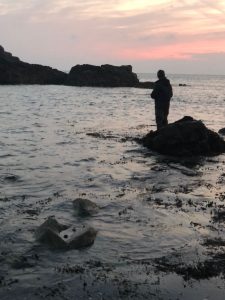
I’ve just returned from a long weekend fishing with the guys from GBASS  and friends, bass fishing on the magical island of Herm.

Dave du Jardin, Bryn Le Poidevin, Simon De La Mare and Chris Topping waiting to board the Herm Ferry.

You’ll understand what a special place this is, and what a great bunch of guys these are, when I tell you that even though the bass fishing was the worst they’ve known, I can’t wait to meet up with them over there again. I can’t thank the guys enough for making me feel so welcome, and being such great company.

My visit had started with a couple of days enjoying the warm hospitality of Bryn and Emma Le Poidevin at ‘La Boulangerie’, their lovely Guernsey cottage. Of course it would have been rude not to sample the steak and local Breda beer at ‘The Driftwood’, while catching up on the Guernsey bass scene on the first evening. Apparently Breda has been the undoing of many an unwary visitor, but I have to report that all was (sort of) well – even after a Pastis chaser back at Bryn’s.

Thursday saw us stocking up on food supplies (including the legendary Perelle ‘sizzler’ sausages) for the weekend, before meeting up with Dave and Nigel du Jardin for a verm digging session. Verm  formed the mainstay of our bait fishing. Collecting it is no easy task, and requires both skill and stamina in equal measures.

Bryn and Nigel – verm kings. Dave and myself were mainly supervising!

Friday morning saw us making the short trip over to Herm. I had to pinch myself as the ferry pulled into the tiny harbour, with the sunshine showing off the island in all its glory. Was I really about to spend three days and nights bass fishing in paradise, with some excellent bass anglers. I reflected on how fate had brought me to this part of the world, when my son came to work on Guernsey as a surgeon some four years earlier.

It was nice not to have to think about where to fish – these guys know the island well, and are more than happy to show you around. Just as well, given the speed the tide can come in on the big springs like we had this weekend. I vividly recall standing in the dark and feeling the coldness of the water moving up the outside of my waders from ankle to knee in the time it takes to make just a few casts.

You can tell how special the place is to the guys, who are keen to show off its many features and its rich sealife.

An unusual marine worm-like creature, apparently found only on Herm.

As I mentioned above, the fishing could have been better, but it’s funny how it almost doesn’t matter whether you catch or not in these circumstances. Every session starts with hope, and every cast brings with it an anticipation of your bait or lure being snatched, whether or not it actually happens .

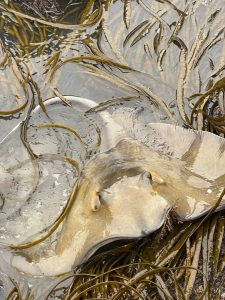
But one bite for Dave turned into something special when he landed a stingray after quite a battle (we thought he had hooked the Herm ferry at one point!). The fish was estimated at 15lb, although no one was keen to weigh it, in view of the nasty wounds they can inflict with the long spine on their tail.

A stingray for Dave du Jardin. Photo credit: Bryn Le Poidevin.

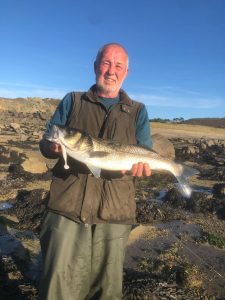
We did catch bass, albeit mostly of modest size, except for Dean’s near 6lber.

A 5lb 12oz beauty for Dean Wilson. Photo credit: Simon De La Mare.

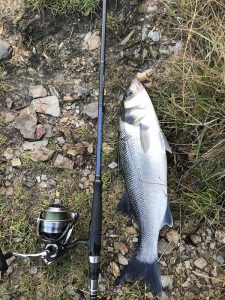
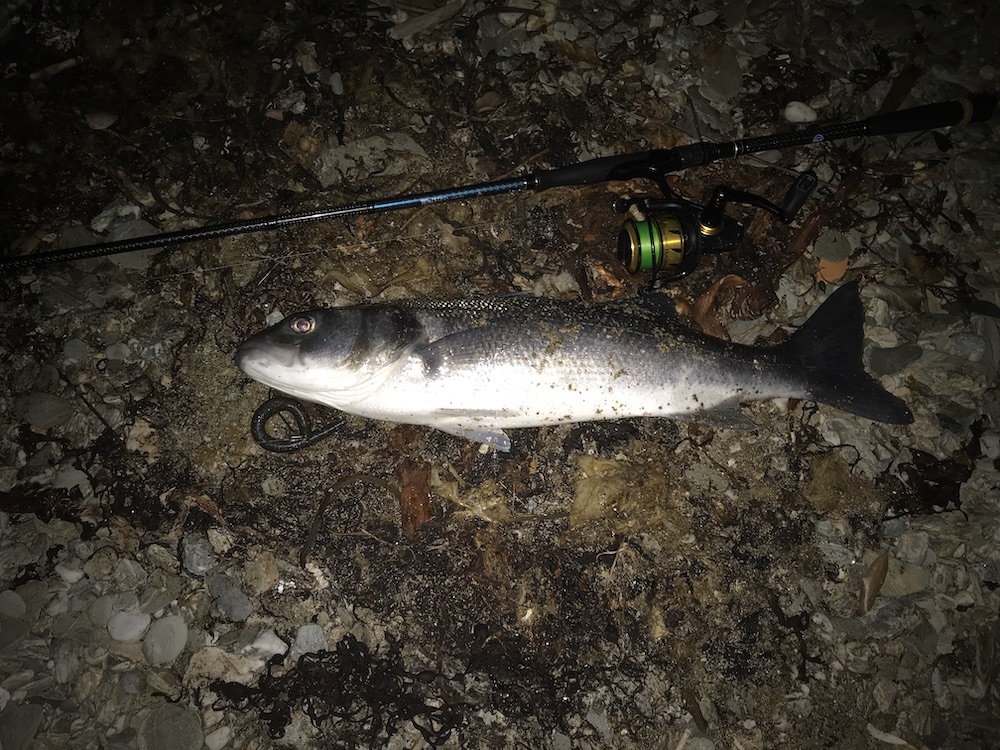
My own best effort  was a 53cm bass caught on a watermelon and pearl 6″ Hawg Senko, just before first light while under the excellent guidance of top GBASS rod Simon De La Mare. Although this fish was of modest size, catching it crowned a moment that will stay with me for years to come. Here I was, fishing a sandy bay somewhere off the Normandy coast on a beautiful island as the dawn approached – priceless! A little later, a move to a nearby causeway produced a feisty 50cm bass, just to cap things off.

An early morning session with lures. The first cast on this rock resulted in a 50cm bass on a wagasaki pulsetail Gravity Stick. Photo credit: Simon De La Mare.

Each session saw a different facet of the island, with its massive tides (up to 10m) stripping out to reveal inter-tidal reefs stocked with copious amounts of food for bass and other species, or its gorgeous sandy beaches.

Fishing by day, in the sort of weather we had (amazing to be fishing in shorts and sandals in the middle of October), brings views of neighbouring islands like Sark.

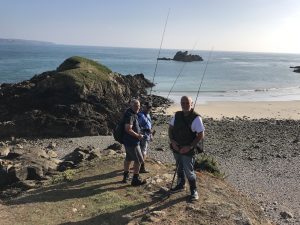
Carl Smith, Simon De La Mare and Dean Wilson heading down to a beautiful Herm cove.

By night the lights of Guernsey across the water seem dazzlingly bright in contrast to the dark skies of Herm. Wending your way to your next fishing session along the dusty spine road, where only people, cows and the occasional quad bike ferrying stuff around are allowed to pass, and hearing the hum of the island’s only electricity generator as you go, reminds you how unspoilt this place is. And instead of that, sometimes long, drive home, it was shanks’ pony back to our holiday cottage for a whisky nightcap (or several) with the boys.

Fishing is about more than just catching fish. It was the reason why I was there, but just being in such a fabulous place, with people who have become good friends, was a far greater reward.

The three bassketeers! Nigel, Bryn and Dave waiting for the ferry back to Guernsey.

Dave du Jardin, the Steven Spielberg of the bass fishing world (aka Mr Stingray) produced this brilliant video in his own inimitable style which nicely captures the essence of the trip; enjoy…….

That’s more like it!

In my last blog I was hoping that this August would be as good as last – well it was! After months of seeing just the odd fish now and again, it’s so nice to be able to go fishing knowing there’s a reasonable chance of catching something. I’m saying this despite not being able to get out as much as I normally would, due to a succession of much-enjoyed family visits and a busy schedule of bass surveys.

Peter Maddern commented on my last blog “August to January is my season these days”. There is a chance of catching bass (including some big ones) earlier in the year, but if you want consistency, I think Peter is spot on, at least down here in Cornwall.

Another estuary mark

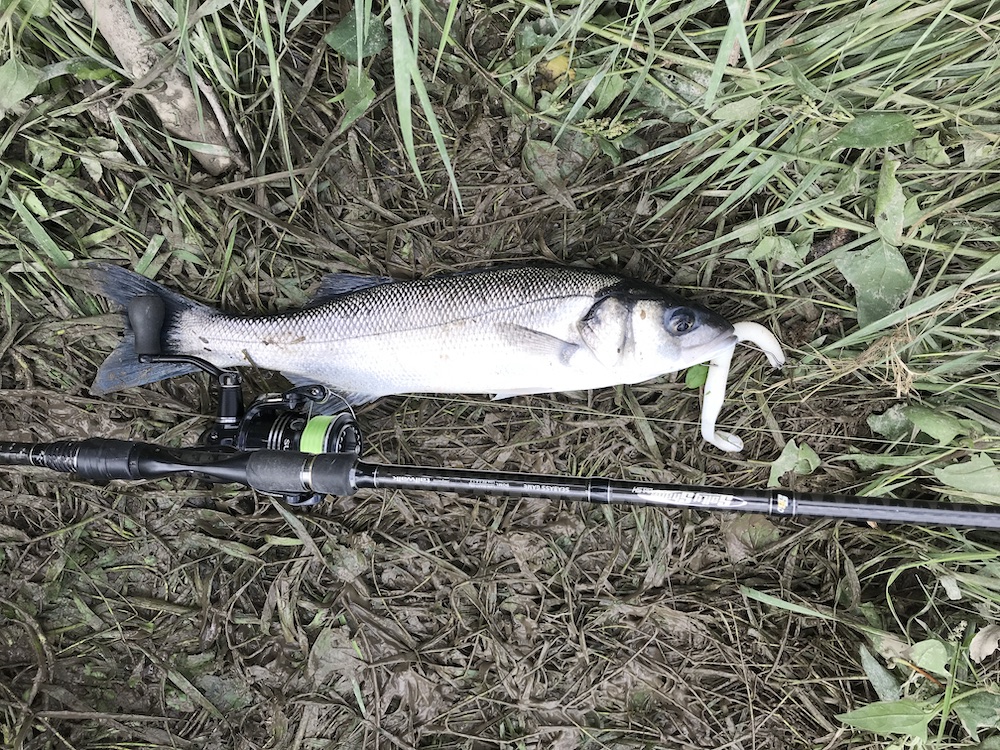
A lone 51cm fish on a DoLive Stick, cast along the shore over some shallow weedy ground after dark in quiet conditions, was enough to confirm the potential of another estuary mark.

An estuary-caught 51cm bass, which took a fancy to my DoLive Stick.

Back to the coast

I’ve been increasing my fishing time in estuaries in an attempt to discover more marks, but when a nice SW wind blew up, suggesting a bait-fishing session on the coast might be worthwhile, I headed for the beach.

Sure enough, there was a lovely sea running when I arrived, but the fish didn’t seem to be biting. Almost last chance saloon time, I put on the tail half of a joey mackerel. This method of mounting a mackerel bait works for me, with the bait coming back as it went out (unless I’ve had a bite of course!), rather than as a lump of mush. I know mackerel head works well, and I haven’t ruled out other methods of presenting it (chunks, fillet, whole joey etc).

I felt the weight move, but because I was fishing across the surf, I assumed this was due to a wave lifting it; I now use braid for my beach fishing, and it’s brilliant for bite detection.

The violent thump, thump which followed left me in no doubt this was a fish, and the ensuing battle to bring it in suggested it might be a good one. The landing was a bit tricky, but fortunately the hook was well set in the underside of the chin of a nice bass ( I remember thinking this was quite unusual), and I was able to get it in. This 60cm bass was the second of this size I have caught  on mackerel, out of a total of three to date; a very pleasing result and I shall certainly be using mackerel more now.

A 60cm beauty, taken on mackerel bait. The bag containing my fishing paraphernalia is left in for scale.

Lure trials

As the month wore on, the fishing improved. With good numbers of fish about, I took the opportunity to do some trials with lures which I had not yet proven, or used for some time.

On the first of a couple of productive lure sessions, I managed eight fish to 50cm, reaffirming my confidence in Sidewinder Skerries Eels, and catching for the first time on one of Sean Stevenson’s Eels and James Lanfear’s Needlefish lures. The second session produced seven fish, again to 50cm, this time allowing me to prove a Sunslicker Swimish Lure, a  Megabass Spindle Worm, and several colours of the excellent 6″ AGM Stick Worm.

Just like old times

The fishing wasn’t all like this though. Angling buddy Paul Wallace, who features regularly in my book, and I finally managed to catch up and get out for some fishing. Disappointingly, our first (lure + bait) session ended in a blank, although Richard Brandon fishing with us managed a 3lber on squid fished close in. The following session with Paul, on lures, did produce a couple of modest fish for both of us. As Paul commented, it was good for both of us to catch, as fishing sessions can so often go in favour of one angler over the other, often for inexplicable reasons.

It was great to be fishing together again – just like old times. I was really pleased that Paul caught, particularly as he is having a shoulder op later this month, and probably won’t get out again until at least November. I feel for him having to miss out at such a (potentially) good time of the year, but hopefully he’ll be able to get among those big fish we sometimes see in December and January.

More estuary success

Knowing my current interest in estuary fishing, Keith Towsey offered to show me one of his marks. It looked like the session was going nowhere, with neither of us having any action, but a lone fish at the end completely turned things around.

As we headed back to our cars, by now well dark, I spotted an enticing-looking small shallow bay of mixed sand and weed-covered rock. A few flicks with a rockfish-coloured 6″ AGM Worm Stick produced the odd tap to revive my, by now, flagging commitment. The next cast was met with a definite take, followed by the satisfying feel of a good bass thrashing on the surface. At 62 cm, this was my best fish of the year to date, and my best ever from an estuary.

A 62cm estuary-caught bass taken on an AGM Worm Stick lure.

Returning the favour

Eager to return the favour, I took Keith to one of my marks on the coast. An early fish for me suggested things might go well, but a couple of hours later we’d had no more action.

As with the previous trip, it looked like it just wasn’t happening, and I was about to suggest that we head for home. Then Keith came up, declaring that he had just had a fish about the same size as mine (48cm) on a Gravity Stick Pulsetail. I had suggested he try a Gravity Stick, as sometimes the paddle (pulse) tail can make a difference if the fish aren’t biting too well and need a bit of geeing up.

We were standing next to one another discussing the best way to retrieve this type of lure. “Do you ever twitch them?” asked Keith. Before I could answer, he had a take, the fish obviously responding to this tactic. “It’s a nice fish” said Keith, as he struggled to bring it in. But in she came – all 67cm of her. A nice fish indeed, which the BASS tape puts at a little shy of 7lb.

A 67cm bass for Keith Towsey, caught while twitching a Wagasaki-coloured Pulsetail Gravity Stick.

While most of the fish I’ve caught have been in the 40-50cm range, there is an encouraging number of 60+ fish around. Hopefully they will be joined by a few 70’s as we move into what could be a good autumn.

Catching large bass in the day

As you can see from my photos, I’m very much into lure fishing at night. I do enjoy lure fishing in daylight, but this is usually in the evening, leading up to darkness. Having said that, on a few occasions when I’ve been fishing in the middle of the day, usually when fishing a competition, or on a fishing holiday, I’ve hooked into, and sadly lost, what were apparently very large bass.  These situations have usually occurred on Spring tides, and when fishing weedy, rocky ground with surface lures. I wonder if there is less competition for those fish brave/bold enough to feed at these times. I’d love to know if others have any thoughts on this.

I had thought about actually targeting bass at these times, and a recent capture of an 8.5lb beauty by Jake Bodie has given me the added impetus to give this a go. Mind you, catching fish like that doesn’t come easy, and Jake points out that this catch was the culmination of a lot of research and putting up with numerous blanks.

An 8.5lb lure-caught beauty for Jake Bodie. Photo: Jake Bodie.

Intriguing catch

Perhaps the most intriguing catch I’ve heard of recently, is a 3lb bass taken on float-fished bacon! The angler was fishing off the end of a pontoon, where children use bacon chunks to catch crabs. Presumably some of this finds it’s way to the area around the pontoon on a regular basis, and the bass become accustomed to this. Whether bacon would work elsewhere is unclear, but worth a try I reckon, although I’m not sure whether smoked or unsmoked, or streaky or back is best!

Leave it in

I am indebted to BASS colleagues, via their forum, for flagging up an interesting article discussing “What happens when the line parts” It’s well known that the post-release survival of deep-hooked fish is not good, but by cutting the line, and leaving the hook in-situ, survival is much improved, especially if using barbless hooks made of materials which corrode.

Juvenile bass surveys

Our juvenile bass surveys resumed at the beginning of August. I always feel a sense of wonder when I see the first fish of this year’s spawning coming through.  These perfect miniatures of the adults we like to catch really are beautiful. I find myself wondering where and when were they spawned? what obstacles have they had to overcome to get here? how many will reach the magic 10lb after 20 years or so?

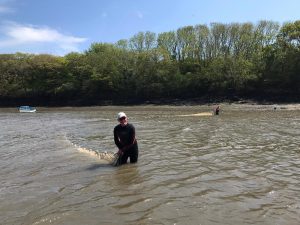
Netting for juvenile bass on the Helford Estuary. Photo: Peter Maddern.

Just when our results seemed to be indicating a poor 2021 year class, a bumper catch on the Fal (1,159 ‘0’ groups) has turned this conclusion on its head. Let’s hope our remaining surveys clarify things. Please be assured that great care is taken to make sure these fish are returned alive.

‘0’ group (this year’s) bass netted in early September. The difference in sizes probably means these fish were spawned at different times. Photo: billy Mathews.

This work is completely dependent  on volunteers, and the bigger the pool, the more surveys we can carry out. If you’d like to help on an occasional or regular basis, especially if you can use your boat, please get in touch via the comments box.

What it’s like to be caught in a rip

I’ve often wondered what might happen if I got caught by a wave while wading in the surf to cast. Watch this disturbing video about a swimmer who got caught in a rip current on Mawgan Porth beach in Cornwall.

That’s all for this month folks, thanks for reading. Do feel free to pass on to friends if you’ve enjoyed it, or leave a comment.

Tightlines,

Bass fishing in estuaries

I used to think that you only caught schoolies when bass fishing in estuaries. It is a fact that most bass spend the early years (up to aged 4) in such areas, so these juvenile fish will predominate, but I’m now convinced that some adult bass (including some big ones) spend their summer and autumn in estuaries, and probably return to the same ones each year.

And why wouldn’t they – with an ample supply of prawns, crabs, worms and all manner of small fish, not to mention the shoals of mackerel when they come in. Of course they have competitors, such as gilt-head bream, and predators, such as seals and possibly dolphins, maybe even tuna at times, but at least they escape the nets (in Cornwall at least – where the River and Estuarine Fishing Nets Byelaw now prohibit the legal use of these).

This new-found confidence in estuaries comes from scientific research – like this study in Cork Harbour in Ireland, from increasing reports of anglers catching good bass while fishing for gilts, and reports of big bass being caught on lures.  It’s making me explore whole new areas, in pursuit of catching a big bass in quiet conditions, away from the big seas on the coast, in tranquil and leafy (creepy at night if you’re on your own!) surroundings.

You can imagine the pleasure it gave me then, when I landed this 60cm bass a few weeks ago while fishing at one of angling friend Stuart Martinez’ marks.

Not only was this my first half-decent bass caught in an estuary, it was taken on a Dark Sleeper lure, which I wrote about in a blog last year.

Get the fork out

With reports of big bass caught in estuaries while bait fishing for gilts, I thought it was time to get the fork out. It’s been a while since I used lug, let alone dug for it, so I wasn’t sure if my old spot still produced, or if I still had the knack of getting them. Undaunted, off I went, wielding my fork and with an expectant bucket in hand.

It was a pity I chose one of the hottest days of the year to date! This, and the fact that I had been fishing late the night before, severely affecting my stamina reserves, did nothing for my resolve. Although there were plenty of casts to be seen, the little buggers didn’t want to come out to adorn my hook – most inconsiderate of them I feel! I did manage a few though (including some quite nice ones) before I sloped off the job, drenched in sweat! (bait diggers have my total respect).

Alas, apart from a couple of schoolie rattles, I had nothing to show for my efforts – not that I would expect to at the first attempt at a new mark. As I sat waiting for a bite, I wondered whether  I was more, or less, likely to catch a big bass with bait or lures in estuaries. Using lures allows large areas to be searched, and  feels like a more targeted approach, especially at night – but is it as effective as bait? I know anglers who have caught big bass on both methods in estuaries, but for the specimen hunter, I think lure fishing has a slight edge.

Bass Nursery Areas

The report on Bass Nursery Areas (BNAs) from CEFAS (Centre for Environment Fisheries and Aquaculture Science) has finally been published. As the report says, the original BNAs (37) were introduced in the 1990s, thanks in no small measure to BASS members like the late Don Kelley, to reduce the impact of fishing in areas where the majority of bass are likely to be below the MCRS (Minimum Conservation Reference size, currently 42cm). BNAs are thought to have played an important role in protecting the stock.

The report details 48 proposed amendments (including 39 new site designations) which were received from IFCAs (Inshore Fisheries and Conservation Authorities) and the MMO (Marine Management Organisation). The report cites a lack of evidence for many of these proposals, and whether ANY of them have been implemented is unclear.

Perhaps this is a question of the standard of evidence required being too high, since surely just the presence of favourable habitat conditions in typical nursery areas is enough to warrant the increased protection gained from BNA status, particularly when bass recruitment is so crucial to stocks and subject to fluctuations in climate and weather conditions at the time of spawning and over the winter.

This is why our juvenile bass survey work in Cornwall is so important, and if anybody would like to help with these please let me know; it really is very enjoyable and rewarding, and only takes up a few hours now and then. Page 15 of the above report shows the existing BNAs. If you think your area would benefit from setting up a BNA, why not contact your local IFCA about it? Better still, why not set up a juvenile bass sampling programme yourself, to demonstrate the need for this? I would be happy to pass on any information I have about this.

Recent catches

Finally, there does seem to be a few bass about down here in Cornwall, although the bigger fish still seem to be few and far between. It’s still very patchy though – the west of the county seems to be having the best of it, while other areas continue to find just the odd fish here and there, although I have very recently heard of some big catches of smaller fish.

Apparently there are lots of baitfish out there – just out of range of shore anglers! The usual mackerel ‘blitz’ we see in July didn’t materialise, so perhaps that’s one reason why many bass have stayed out;  perhaps it also explains the late showing of tuna, which have only recently been reported.

August was one of my better months last year, so I’m crossing everything that this year will be the same. It started off well last night – nothing big, but very enjoyable fishing. This is one of my favourite times of year, with warm, still nights, fishing in quiet conditions with light gear where you can feel every knock, and twist and turn of the fish as they fall for your slowly retrieved soft plastic lure in the darkness.

One of the bass I caught, a 49 cm fish, took the lure just as I was about to lift the lure out of the water. The first I knew of it was when there was a great splash as the fish tried to nail the Dolive Stick sandeel imitation as it was about to run out of water.

Jellies everywhere

There seem to be jellyfish everywhere, especially the compass variety.

Be careful if you come across these, as they can give a nasty sting. A friend of mine discovered this when we came across loads of these in our sandeel net – one of them leaving a nasty red mark on his arm. Unfortunately the sandeels were mostly too small to be of use.

State of bass stocks

It’s at this time of year that I eagerly anticipate the ICES annual stock assessment for bass.   As you’ll see from the graphs in the linked document, things are still pretty precarious with the Spawning Stock Biomass (SSB), and the spawning success (Recruitment) in recent years is nothing to write home about.

Bass Fishing Guidance 2021

Given the state of the stocks, you might wonder why any changes in the Bass Fishing guidance for 2021 were made.  Not that these affect recreational bass fishing, which still only allows Catch & Release in Jan, Feb and Dec, and  two fish per day (over 42cm) from Mar – Nov. On the commercial side however, the Government have seen fit to allow shore based netting for bass, mostly in the Northwest, and in Wales; not only will this damage bass stocks, it could well interfere with the abilities of anglers to carry out their activities.

And there’s been more subtle changes – like the slight increase in bass allowed to be kept from trawls and seines, and the fact that bycatches of bass in nets only have to be ‘unavoidable’ if outside England and Wales.

An unusual fish

I received an interesting email from angling friend, and legendary bass author (Hooked on Bass), Alan Vaughan about an unusual bass he had caught – a fish of 66cm which took an Evostix lure with a small lead-head. It was an exceptionally dark fish, with a large head, “a very energetic bass that gave the kind of fight that we all like”. Alan also noted that it was a slim fish, and weighed 5lb 2oz.

The weight for length and appearance suggested a recently spent fish, yet this would be unusual for this time of year, and the fact that it gave such a good fight also goes against this.

Alan also mentioned that it was a male fish. This is unusual in itself, since male bass over 4lb are very unusual. This got me thinking about length to weight comparisons used in tapes etc. Estimates for larger (4lb+) fish will mainly be based on female fish, since these predominate. So I wonder if the relationship for male fish might be different, and whether this might account for the lower weight of Alan’s fish?

The  fact that most larger bass are female also interests me. This is not unique to bass, and a recent scientific paper  suggests that this is because male fish are more active than females, so that less of the oxygen they obtain from their gills goes into growth; could this account for the excellent fight Alan’s fish put up?

The sex of bass is not genetically predetermined. Whether they become male or female is influenced by the water temperature during their early development (around 6 months), with warmer water  resulting in more males. Water temperatures are likely to increase with global warming, and are likely to exceed 20C on occasion in the shallow estuaries where ‘0’ group bass tend to live in the summer. So could we be seeing more male bass in the future? Will this mean more hard-fighting, but smaller bass? Which would you prefer? Come to think of it, would more, sexually mature, male bass (but fewer females) mean increased or reduced spawning success?

That’s it for this month folks. Thanks for reading, and if you enjoyed it please pass on to friends.

A bass angler’s fascination with marine biology

Marine biology has always held a fascination for me. In my working life I chose a different scientific route, in NHS Pathology, but I never lost my love of marine biology.

The sea got into my blood at an early age, while living in Malta, but it was a vacation course at Bangor University which really cemented my love of the scientific study of marine life. We studied the rich diversity of seaweeds and the myriad of tiny planktonic creatures which abound in the Menai Strait.

This was as a schoolboy from Oxford, and long before my obsession with bass began. Had I been as interested in the species as I am now, I would have taken full advantage of the opportunity to learn as much as possible about Dicentrarchus labrax.

My love of bass fishing has both indulged, and furthered my love of marine biology. In thinking about catching these wonderful fish, you cannot help learning about their habits and feeding, and what makes it possible to catch them.

But with me it goes further than that – to where they spend the different phases of their lives, and how they reproduce and migrate; in short their life cycle. This article by the BASS science group summarises our current knowledge in this area, but with the amount of research which is going on in  this field, it will hopefully soon need updating.

Spawning success

One aspect of the bass lifecycle which holds particular  fascination for me is the success, or otherwise, of each year’s spawning. This is crucial to the survival of bass as a species, and being able to assess the strength of each year class, and it’s growth, gives important research and fishery management data. I have been fortunate in being able to participate in the juvenile bass surveys run by Derek Goodwin in Cornwall.

Last year’s survey programme was severely curtailed by the Coronavirus pandemic. It’s been good therefore, to be able to resume the programme this year, and carry out a reasonable number and range of surveys. We’ve reached the mid-point of our programme for 2021, so now is a good time to take stock.

In May and June, we are primarily looking for one year old bass from last year’s spawning, the so-called ‘1’ groups.  Results should (hopefully) confirm our estimates of year class strength for the previous year, and check that fish numbers have not been unduly affected by prolonged (more than three weeks)  spells of very cold weather over the winter; these can kill young bass off if they have not made sufficient growth (to 6cm) before the winter starts.

Due to very limited sampling last year,  we just weren’t able to get a fix on how good the spawning, and settlement – the movement of larvae and fry from spawning grounds to inshore areas – had been for 2020, at least as far as the south coast of mid-Cornwall is concerned.

So it was encouraging to find ‘1’ groups on all our surveys (apart from one site in the Fal which was being trialled). And as the summer has progressed, the results have improved. The numbers we’ve seen have increased to around 200 per survey in both the Fal and Helford. These are not the big numbers (~2,000) we see after a really good spawning year, but are nonetheless encouraging enough to say that the 2020 class looks like being a reasonable one; perhaps one silver lining from the awful Covid cloud? I should add that all the fish we catch are carefully returned.

Netting on the Helford river. Photo: Frank van Veen

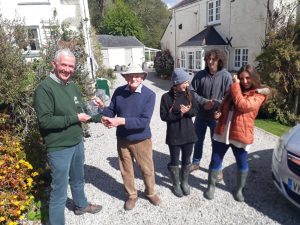
Another silver lining was Derek Goodwin’s John Leballeur Conservation award from BASS, in recognition of his many years of juvenile bass sampling in Cornish estuaries. Having recently undertaken the running of the surveys on Derek’s behalf, I can vouch for how richly deserved this award is. I was very pleased to be able to present the award to Derek on behalf of the BASS Committee during one of our recent surveys. Derek’s latest award comes soon after he was awarded the MBE for services to the study of fish populations in Cornwall.

Photo: Craig Baldwin

The survey programme is. suspended during July, since the incoming fry don’t withstand the rigours of netting well due to their small size (~3cm). Work will continue, exploring potential new sites, but we won’t resume netting until August.

The second phase of the programme, during August and September, aims predominantly to assess the number of this year’s bass, the so-called ‘0’ groups. It’s difficult to predict what we might find, but the cold spring we had, with a run of easterlies in April, can’t have helped.

A big thank you to our brilliant volunteers, without whom this important work would not be possible. If you would like to help, particularly if you can spare time during the week, please let me know.

Recent catches

In my last blog, I said that if things hadn’t taken off by the time I write my next one I’d be getting worried. Well from where I’m standing they haven’t, and I am! Despite having an almost unshakable optimism that ‘they’ll be in soon’, doubts are beginning to creep in. These doubts are fuelled by the untold damage done to stocks by gill nets, and the new threat of ‘Fly-shooters’ which the authorities are seemingly unable, or unwilling, to do anything about it.

Yes, there are reports of good catches occurring, especially further east and north, but down here in Cornwall these seem to be few and far between, both on the coast and in the estuaries – even in boats.  A recent all-day boat trip with Steve Ainsworth yielded only 3 bass to 4lb – mind you, he did catch a nice pollack of around 11lbs (although I think he would have preferred it to have been a bass!).

Steve Ainsworth’s nice pollack.

Some encouraging reports of fish to 7lb are beginning to come through, but it hasn’t happened for me yet.

One of these reports involved local angler Bryan Robinson, who caught a nice fish of 6lb 4oz this week:

Bryan with his 6lb 4oz bass.

Imagine Bryan’s surprise when he found this in the fish’s guts:

Just shows what bass will eat!

Bryan thinks it might be a young turnstone, or something like that; at 10-12 inches long you wonder how the fish managed to swallow it!

One possible scenario, says Brian, is that the young bird had fallen out of its nest and been ‘mullered’ by the hungry bass; obviously the fish still felt hungry enough to snaffle Bryan’s peeler crab bait, even though the bird was only partially digested.

A new fishing companion

Readers of my book A Bass Angler’s Life  will know how much dogs are a part of my life. We lost Toby   back in October and had decided not to have another dog. Well, once a dog person, always a dog person; we weakened and nine months later we collected our latest addition to the family, young Archie.

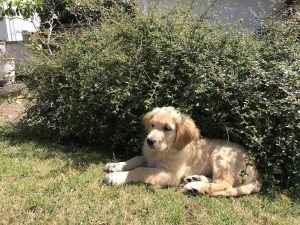
Archie – my new fishing companion

It goes without saying that no dog will ever replace Toby, but it looks like Archie is going to make his own mark on our lives. He’s not quite ready to go fishing yet, but as soon as he’s a bit bigger, and learned not to ‘retrieve’ every lure I cast, or charge about frightening the fish (if there are any left!), he’ll be by my side at the water’s edge – day or night.

Peter Macconnell RIP

It was with great sadness that I heard the news of the sudden death of my friend Peter Macconnell. I never actually fished with Peter, but we had many conversations on the phone about fishing, family, dogs and BASS. I will always remember our epic journey to the BASS AGM in Gloucester in 2018 – the year of the ‘beast from the east’, coming back along the A30 in the snow and almost getting stuck for the night!

I was honoured when Peter agreed to write the forward to my book, and this will serve as a permanent reminder of him. This tribute from BASS is very fitting.

That’s it for this month folks. Thanks for reading and Tightlines.

The next generation of bass anglers

With Father’s Day fast approaching, my thoughts turn to fishing and family. As passionate about fishing as most anglers are, family is still the most important thing in their lives. My book, A Bass Angler’s Life, is dedicated to, among others, my family: “To Angela, Ben and Sarah, who never minded when I wanted to go fishing, and always humoured me when I wanted to tell them something about it, or go looking for new spots”

With many anglers, a family member, or relation, was in some way instrumental  in them taking up fishing. My own father took my brother Peter and I fishing while on holiday in Scotland, and this triggered a lifelong passion for angling. The magic ‘tug-tug’ as another obliging flounder took our cockle baits, legered on thick lines and heavy weights from a wooden frame, has never left me.

Alas, my own children never felt that indefinable thing which makes anglers so ‘hooked’ on fishing, whatever the species or surroundings. That thing which, at times, can occupy our every waking moment (and even our dreams sometimes!), obsessing about marks, tides, weather, methods, and of course ten-pounders laying at our feet.

It wasn’t for the want of trying though, as this photo of a young Ben with an estuary schoolie, caught on float-fished live prawn shows:

Estuaries are good places to introduce youngsters to fishing, with their gentler conditions and usually obliging schoolies. Ah well – maybe the grandchildren will take to it!

It’s important that young people have the opportunity to try fishing, and we can all help in this by taking a family member with us once in a while. Hopefully this will lead to some of these youngsters becoming the next generation of anglers, without which this wonderful pastime has no future, and will become just the stuff of whisky-haze nostalgia.

What excites kids (including 60+ year-old ones!) most about fishing is catching fish, so we owe it to them to look after the stocks, and fight for more and bigger bass. By following and supporting groups like Save Our Sea Bass, the campaigning arm of BASS, you can do your bit to this end.

Recent catches

Well, the foxgloves are out in force now (see my last blog), but the bass don’t seem to be! There are some encouraging signs, like this 53cm bass I caught on the North Coast in mid-May:

A 53cm bass taken on peeler shore crab. Thank goodness the temperature has finally warmed up, and the wooly hat is no longer required!

followed by another of 56cm on the next cast. Both these were caught on crab, from my own traps, but we have struggled to find either fish or crabs since then. I have yet to catch a bass on lures this year.

It can be a bit worrying when the fish don’t show – have commercial catches finally damaged the stocks to the point where even our reduced expectations can’t be met? But don’t give up just yet – there could be other factors contributing. Mind you, if things haven’t taken off by the time I write my next blog I’ll be getting worried.

Keep fish wet.

I came across the excellent Keep Fish Wet website. I like its philosophy: “Our goal is to create a supportive community for learning and sharing best practices for catch-and-release. We do not support finger pointing or shaming.  Keep Fish Wet is not opposed to the lawful harvest of fish. We also acknowledge that even when we ‘catch and keep’, we often return some fish to the water (due to size limits, closed seasons etc.) and therefore practice catch-and-release. Keep Fish Wet best practices can be applied to any type of fishing in any type of water anywhere in the world.”

For any fish which you want, or need to, return, it makes sense to maximise its chances of surviving and recovering as quickly as possible. When I wrote my book, although I had stopped using treble hooks in order to minimise fish damage, I did not see the need to go further and use barbless/debarbed singles. But subsequent experience has taught me that even single hooks can take some time to extract from a fish if they are barbed, and this adds to the time the fish is out of the water. All my plugs are fitted with singles now, and I’m replacing these with barbless patterns.

I know I’m probably missing small bass by using single hooks, and whether barbless hooks also reduce the number of fish landed is unclear – but that matters much less to me than a returned fish surviving, and fully recovering after I’ve caught it.

That’s it for this month folks, but I can’t close without a mention for Pete Ryan, who I met while out fishing the other night. Pete recognised me (even with the wooly hat on!), and his first comment was to say how much he enjoyed my blog. Thanks Pete, it’s so nice to get that kind of feedback.

Tightlines, and best wishes to you and your family.


Time to go bass fishing!

When the foxgloves come out it’s time to go bass fishing – as somebody told me years ago.  There’s no obvious link between the two, yet the saying is usually pretty reliable. There’s no sign of foxgloves in my area yet, so perhaps the explains the lack of fish at the moment! Maybe they’re both feeling the effects of the cool spring.

I’m not saying you won’t catch bass before this, but if you want to focus your efforts, this is a good time to think about starting. If you want to be more specific “The second set of springs in May” is another good time to aim for.

Recent catches

After an encouraging March, April was very disappointing in terms of bass catches. Just one schoolie was the sum total of my catches from nine (mostly chilly!) sessions (mainly bait). I don’t think I was alone though, with those anglers in Cornwall who actually went fishing reporting the same. Other areas (Dorset, Wales, Sussex) seem to have  been more productive though.

Reverse migration

With so few anglers fishing at this time of year, it’s difficult to draw too many conclusions, but a pattern seems to be emerging, and I would be interested in the views of others. Looking back, these catches in March are quite regular and consistent, and are probably due to a reverse migration, where fish are making their way back to their summer feeding grounds. The angler who is prepared to brave the chilly weather at this time could well hook into the fish of a lifetime.

By April, most of the fish seem to have moved past Cornwall’s shores, bringing early results to anglers further up the line. I say most, because there is still a chance of connecting with a hefty specimen down here; the odds are against you, but you could just hit the jackpot.

But it’s not until May that most of the resident bass return to Cornwall, and fishing should become more consistent. By resident, I mean those fish who habitually return every year, and spend the summer and autumn feeding in the same localised areas, exhibiting so-called ‘site fidelity’.

Exploring

One of the highlights of the early part of the year for me is using the quiet time to discover new marks. In recent years however, I’ve run out of steam a bit on this. I think this is partly because there aren’t many places in my part of Cornwall I haven’t already checked out, and partly down to a desire to consolidate what I already know, and turn this into actual results.

Bit when an old and trusted fishing partner suggests looking at somewhere, it spurs you on to make the effort.  Steve Ainsworth and I like fishing the same sort of weedy rocky ground, with lots of ledges and gullies, so I knew it would be worth the effort. Without giving anything away, the ‘bassometer’ was going off the scale as we checked out the mark, with visions of great fishing nights of the past being repeated. This mark had everything – boulders for lure fishing over, gullies and flatter ground for legering. And it was so enjoyable just to be on our beautiful, inspiring Cornish coast again, now that the Covid restrictions are easing.

One area of my fishing where I  still have much exploring to do is estuary bassing. Now convinced that larger bass do live in estuaries for much of the year, working out where to fish for them is high up my list of priorities. But it’s like starting all over again, so I’m anticipating my catch rate suffering a bit. Only time will tell if this is a price worth paying,  but  I’m looking forward to finding out.

Water temperature

The relationship between bass fishing and water temperature is a complex one. Localised warm, or cool spots may cause a temporary increase, or decrease in bass activity, depending on how long they spend there, due to the fish being poikilothermic (their body temperature varies with their surroundings).

A temperature of 10C is thought to be the trigger for bass to begin feeding. Yet they will still feed in water temperatures of 7.5C, although probably less often since it takes longer to digest their food at this temperature.

When thinking about when bass fishing will really take off, I have always set more store by the time of year than water temperature (allowing for year-to-year variations), since this determines whereabouts the fish are in their annual cycle of movements – as the old saying goes, if the fish aren’t there you can’t catch them.

But once they are there, the water temperature may make them more, or less active, and make their food take longer, or shorter, to digest so that feeding will take place less or more often. Rising water temperatures may also make their inshore food more active – whether this makes them more attractive to bass is uncertain, but it will make them grow faster, providing a bigger meal for a hungry bass.

Bass surveys

We have just begun our 2021 juvenile bass surveys in Cornwall. In May and June, we’re looking for juveniles from last year, or earlier. This helps to support our assessment of the previous year’s spawning. However, since our surveys were severely curtailed by Covid last year, we weren’t able to draw any conclusions about the strength of the 2020 class, and the work we are doing now will be our main opportunity to assess this.

Our latest survey results were encouraging, which is a good sign for the strength of the 2020 class.

Measuring juvenile bass from the 2020 class. Photo: Craig Baldwin

With regard to this year’s bass spawning, I’m a little concerned about how well the larvae and fry will have grown, given the cooler temperatures we’ve had recently, and how many will reach our coast and estuaries this summer, given the run of easterlies we had a few weeks ago. We’re keeping our fingers crossed, but we won’t know until we start looking for the ‘0’ groups in August.

All the best, and tightlines.


Here come the big girls!

My buildup for the bass fishing season ahead was given a sudden boost by news of Cornwall angler Jordan Griffiths’ superb 10lb 5oz bass, which can be seen in the featured image above.

What a fantastic achievement by Jordan, who’s not been fishing long. “After a year and half of fishing can say I’ve caught a fish that I will possibly never beat, I’m over the moon!! ” There’s many an angler (myself included) who have yet to land the magic ‘double’ after fishing a lot longer than that, so well done Jordan.

He caught the fish on bait – squid and cart. If, like me, you’re unfamiliar with ‘cart’,  it’s made from the insides of a brown crab.  Jordan cuts open the squid, puts a small amount of cart inside the squid, and binds it together with bait elastic.

Jordan’s is not the first big bass I’ve heard of being caught at this time of year in Cornwall, but they’re not exactly commonplace. These fish are probably making their way back to their summer feeding grounds. Some may not have spawned yet, and a bass the size of Jordan’s could contain around 2 million eggs, so well done to Jordan for returning her to the sea.

Great to be by the sea again

Over the last few weeks I’ve been getting ready for the coming season – checking out rods and reels, topping up on bits of tackle etc, in anticipation of the ‘stay at home’ Covid requirement coming to an end on March 29th.

The day itself coincided with some very big tides, so some razor collecting was on the cards. If you’ve never done this, have a go – it’s great fun, and they make superb bass bait (and eating – apparently).

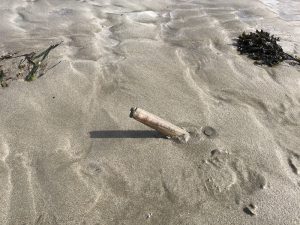
To show a razor clam coming up after salting
A razor fish surfacing after salting.

It was wonderful, driving to the coast and being by the sea again, especially on such a beautiful spring day; a real tonic for lockdown blues. I used to be able to collect enough razors for the season in one go, but not now. So I was off again the next day, to another venue. I should have enough to last a while now, and there’s another set of suitable tides for collecting at the end of this month.

While in bait collecting mode, I decided to check my crab traps out. This was mainly to clear them out, after silting up over the winter, so I was pleasantly surprised to see that the spring peel had already started. And I landed a schoolie on one the other night – my first bass of the year.


Freshly-collected peeler shore crabs

Can fish feel pain?

A recent news item from the Angling Trust contained a reference to a paper entitled “Can fish really feel pain”, which concludes “fishes are unlikely to experience pain”. Not long after this, I watched the “Seaspiracy” film (more about this later) which also raises this subject. Wanting to know more about this difficult and controversial subject, I did a literature search.  I found this more recent paper (among others) entitled “Evolution of nociception and pain: evidence from fish models”, which concludes that “it is highly likely that fish experience pain”. So there seems to be conflicting messages out there, and the fact is that it is impossible to provide a definitive answer to this question, since fish are unable to communicate directly with us.

If we accept that fish may have the hardware to experience pain, does this mean they actually feel it, in relation to angling activities? It’s not as simple as yes or no  – different parts of the body may have different pain thresholds. Being able to feel pain is held out as a good adaptation, which allows animals to avoid injury. But what if this were to put a fish at a disadvantage? Fish eat all manner of spikey objects, and if they felt pain in their mouth this would surely discourage them from doing so, potentially leading to starvation.

I well remember hooking a good fish, only to lose it in a snag. A little later, my fishing partner hooked, and landed a bass of about 5lb – with my hook and elastic band in it’s throat! Clearly this fish had not been put off by its encounter with my hook, and me pulling for a break.

No doubt the debate will rumble on…………

Seaspiracy

This Netflix film is quite a difficult watch in parts. One of the standout features is the damage being done to the planet by commercial fishing. Equally disturbing is the apparently passive acceptance of this by some marine conservation groups. I experienced this myself, when raising concerns about immature bass being caught in gill nets with too small a mesh size.

Feeling the pressure

Another excellent article from Alan Bulmer “How fish use their later line” contains some useful lessons for the lure angler.

A fish’s lateral line senses pressure waves, but it seems that this is only efficient over short distances (less than one body length). “Experiments have also shown that fish rely on sound and sight to detect prey and approach it whereas the final strike and catching of the prey is mostly based on the lateral line.” “When the water clarity is poor, or in low light, the importance of the lateral line in locating prey becomes critical.” So presumably your lure needs to be passing quite close to a fish for it to be detected in the dark, or in coloured water, since sight is much reduced and sound pressure waves cannot be perceived by the lateral line.

“Torpedo and arrow body shapes give off less pronounced oscillations when moving through the water than sinuous eel like shapes.” Does this mean that soft plastics catch more bass at night? But that’s presumably not taking into account the good vibrations that many plugs give off. I’ve caught bass on both in the dark, although I tend to use soft plastics more now – mainly because I don’t have to worry about snags so much.

“Changing treble hooks for singles, replacing split rings or increasing the gauge of hooks used could completely change the pressure wave “fingerprint” and attractiveness of a particular lure.” I change the trebles on all my plugs to singles, and I’ve not noticed any effect on catches yet, other than perhaps losing the odd schoolie. I think it helps to get the weight of the singles + split rings as close as possible to the  original trebles + split rings, at least for shallow-diving plugs.

That’s it for this month folks. Tightlines to you all, and let’s hope one of those big girls come your way.


Will 2021 be a better year for bass anglers?

We’re at that special time of year for bass anglers. We’re full of anticipation for the season ahead, our heads filled with plans to try this and that – a new style of fishing, a new lure or bait, new marks, or improving our personal best. You might be contemplating getting a new rod or reel, some new boots or clothing, and almost certainly some new lures.

Even though I know the bass fishing was less than spectacular last year, that sense of optimism I always feel at this time of year doesn’t desert me. Maybe things will be better this year; maybe I wasn’t fishing in the right places, or at the right times before? But perhaps my optimism is misplaced – only time will tell, but I’ll have a lot of enjoyment (or frustration!) finding out.

Plans for 2021

So here we go on the annual bass merry-go-round again. I think it’s important to have a rough idea of your aims for the year; not too prescriptive – remember you want to actually enjoy this! In my case this year will be about more time in estuaries, more time in the boat, and catching that double.

Of course, this year should hopefully see things improving with the Covid situation, allowing a return to (new?) normality eventually – fishing with friends without having to worry about infecting them (or being infected), not worrying about touching that gatepost, being able to travel as far as you like.

Roadmap

Vaccination is central to the Government’s roadmap out of the Covid situation. I had my first shot of the Oxford AstraZeneca vaccine on February 19th, and have the second one booked for May 7th. There was some initial delay, waiting for a call from the GP, but once I found out that they weren’t doing our cohort (5) it was plain sailing. The people at the local Pharmacy where Angela and I had the jab were very pleasant, and the whole system was very efficient. It was good to get vaccinated, but more than this, I was so proud of our marvellous scientists, healthcare staff, armed forces and volunteers.

From March 29th, people will no longer be legally required to stay at home, although travel should still be minimised wherever possible, and people should not be staying away from home overnight at this stage. I’m interpreting this to mean that I can make short journeys to the coast, with perhaps the odd longer one thrown in as well.

Very fortuitously, this is the very time when I normally look to start bassing again. The fishing isn’t pretty at this time, often involving long, fruitless hours on cold nights, hoping to intercept a big fish returning to its summer feeding grounds. Some very large bass have been caught at this time, so it’s worth sticking it out if you can.

The dangers of fishing

Fishing can be a hazardous business. Every year we hear of the tragic loss of an angler. Watch this moving video about Tyler Westlake’s sad demise.  Please make a donation to the RNLI to help continue their vital work.

Take action on gill nets

One of the reasons, perhaps the main one, for last year’s poor fishing has to be the amount of gill netting going on. Early January saw the aggregating and pre-spawning bass being hammered once again. I often wonder why it’s only bass anglers that seem to care about bass conservation, and what we can do to get the public involved in stopping things like gill netting.

Enter Whale and Dolphin Conservation, with their  campaign to reduce the cruel deaths of dolphins and other cetaceans from gill nets. Please take a minute to check this out and let the Government know what you think about gill nets.

Recent catches

I’m not hearing of much being caught locally at the moment. Mind you, I doubt there are many anglers actually fishing for bass. I suspect this is down to a combination of poor catches at this time in previous years, and less comfortable weather to fish in. It will be interesting to see if the situation changes as more anglers fish through the winter, which I suspect is already starting to happen.

One thing of relevance here is the number of pilchards around. Large numbers were seen on the North Coast at the end of January, and on the South Coast during February. So there’s plenty of food for the bass which haven’t gone off to spawn.

Distribution and growth of bass

I obtained this useful map showing the distribution of bass from the NWIFCA website (with thanks).

Distribution of bass.
By Etrusko25 – Own work, CC BY-SA 3.0, https://commons.wikimedia.org/w/index.php?curid=9578557

It’s interesting to note how far north (Norway) and south (Morocco) they can be found.

The late Don Kelley tells us in his book Life with Bass that bass grow faster on the Biscay coast (about 50% faster by weight). He also notes that in the overall range (of bass distribution), the fastest growth occurs in the Mediterranean, and that a bass of 7 years old caught at Sete in southern France weighed 7lb – in the UK this fish would weigh about 2lb!

Said Elhabchi, fishing off the Morocco coast, caught an enormous bass of 11.5kg (~25lb) back in 2014. This fish was 24 years old. A UK bass of 10lb  would be about 20 years old, so you can see just how fast Said’s fish had grown!

Said Elhabchi’s fantastic 11.5kg Moroccan bass.

Otters on the coast

Otters seem to be having something of a resurgence. I always pictured them in freshwater streams, but an interesting article from Roseland Online notes that they can move between rivers, estuaries and the sea, and their diets include marine fish such as bennies and gobies, and crabs.

An evening with Cornwall IFCA

Many thanks to the Angling Trust for hosting a recent online event with Sam Davis from Cornwall Inshore Fisheries and Conservation Authority. Sam noted that communication with anglers could be improved, and this meeting was a useful step in the right direction.

Sam told us about the fisheries management and research work which CIFCA undertakes, and about the limitations they have to operate within.  It must be difficult trying to manage fisheries with such limited resources, trying to meet the sometimes competing needs of different stakeholders.

Yet I cannot help feeling frustrated by the glacial pace at which change seems to happen under CIFCA’s leadership with respect to bass. And Sam’s attempts to manage expectations worked well; nothing I heard from her gave me any confidence that bass would gain any meaningful protection from coastal netting anytime soon. It was so heartening to see the Estuarine nets bylaw introduced in 2018, but since then things have stalled.

I also came away feeling that anglers as a stakeholder group are not given sufficient weight. Yes, we understand that commercial fishermen have to make a living from the sea, but so do lots of angling businesses. In 2019 there were around 12,000 fishers working on UK registered commercial fishing vessels, landing fish with a value of £987 million. In comparison, on average 823,00 UK residents (aged 16 and over) went sea angling in the years 2015-2017  with a total economic impact of £1.94 billion and supporting 16,300 jobs in 2017.

And why is it assumed that angling is less important than commercial fishing – how would people feel if they were picking blackberries and someone pushed them out of the way because they wanted to collect them for money?

That’s all for this month folks.

Tightlines, and good luck for the season ahead.

Spring, and bass fishing, is just around the corner

Here we are in mid-February. We’re in the midst of another lockdown, the weather is misbehaving, and for most of us bass fishing is a little way off yet.  But let’s look on the bright side – things are improving on the Covid front, the days are getting longer and spring is just around the corner (March 1st to be precise, or 20th if you go by the astronomical seasons).

Walking solo

At least we can get out for our daily ‘exercise’. It seems really odd though – not being accompanied by my best friend Toby. This is the first winter since he passed away, and I miss him so. I’m getting out every day though – rain, shine or brass monkeys. I’m staying local, walking from home, and I’m fortunate to have a good variety of routes to take, many bringing back memories of the old boy.

A winter walk with Toby

Missing the coast

At this time of year I’d normally be out exploring new marks, or just enjoying favourite walks on our wonderful coast, making a day of it in the sunshine. But of course that’s out of the question at the moment.  I do miss the coast, but this is a small price to pay in the grand scheme of things, and hopefully it won’t be long before we can travel further afield again.

Catches

I’m not fishing myself at the moment; not that I could if I wanted to, with the huge seas we’ve had recently. I do very little fishing in February as a rule – perhaps just the occasional trip if the weather is kind, just to test the water, so to speak. I’ve been keeping myself busy though, spending my time preparing a talk, and writing stuff for BASS.

I am hearing of occasional anglers getting out recently though. Danny Richards has been getting some bass. One session earlier this month he and a mate caught 28 between them, mostly smallish, on bait. That he was catching so many bass at this time of year is interesting, particularly when some of the 2lbers were running with roe. This suggests to me that either these fish were very late to migrate, or that there might be an inshore spawning area nearby.

A February bass for Danny Richards

Bass are thought to spawn mainly in the western end of the English Channel, and off North Cornwall, but there may well be other areas, and these may be changing with global warming, since water temperature is important for spawning success.

Beast from the East?

The very low temperatures and strong E/SE winds blowing from Scandinavia we’ve had recently are reminiscent of the ‘Beast from the East’ of 2018. Fortunately this one doesn’t seem quite as ‘beastly’ as the last – at least in terms of duration. This is just as well, since the tiny basslets from last year’s spawning don’t do well in prolonged (more than about 3 weeks) very cold spells. I’ve been watching the forecast with more than little trepidation recently. This is also a crucial time for bass spawning, so let’s hope we don’t see too many more easterly blows like we’ve had of late.

Reading beaches

The seemingly featureless nature of beaches can  make them hard places to fish consistently. But although these features, or structures, may not be as obvious as those on rocky shorelines, they are there.

I’m indebted to a Facebook commenter for bringing Rich Troxler to my attention. For those who have not seen this previously, his video “Reading The Beach – Sandbars, Troughs, Dips – Let The Water Tell You Where to fish” really gives a great insight into how to improve your catches from beach fishing.

Bass Minimum Landing Size

I must draw your attention to a superb article from Malcolm Gilbert entitled The Bass Minimum Landing Size Debacle. You can access this via the BASS blog.

Malcolm makes some very powerful points about the painfully slow progress in bringing about the current MCRS of 42cm, and the folly of years of heel dragging by the commercials.

Two points struck me in particular: (i) we still need to increase the MCRS further (to at least 48cm) to give most female bass a chance to spawn at least once before being harvested, and (ii) why has it been left to anglers to fight for the MCRS to be increased – where are the Conservation bodies in this?

The more widely Malcolm’s document is seen, the more likely it is that support for a further increase in the MCRS is gained, so please share with others; I have made a start by sending a copy to my MP.

Ikigai

I recently gave a talk (on Zoom) on bass fishing to a local U3A (University of the third Age) group. Commenting at the end of the talk, the Chairman, Dr Roy Fisher, spoke about Ikigai, the Japanese concept of finding purpose in life, and its association with longevity. It’s what gets you up in the morning, and keeps you going. Having a hobby that you’re really into is good for ikigai, and the Chairman thought my talk demonstrated that I had plenty of it!

Fishing is something that appeals to all ages, and because it can be practiced in many different settings, it’s possible to carry on doing it into later life; I’m certainly planning on going fishing for a good few years yet!

That’s all for this month folks; thanks for reading. Keep safe, and let’s hope things improve in time for the early bass run. In the meantime, why not pick up a copy of my book to while away an hour or three; you can see an electronic preview of this here.
 

What happened to all the bass?

After a stop-start summer I was really looking forward to a lengthy spell of good bass fishing through the autumn and into winter. Well, basically it just didn’t happen. I managed quite a few trips right up until the end of the year, in between the storms, but the fish were hard to find – in fact the last bass I caught was on December 2nd.

So what happened to all the bass? You don’t have to look far to see what is the most likely cause. The amount of illegal netting for bass going on down here in Cornwall (which will have implications for stocks in other areas too) has been exposed by Save Our Sea Bass. Commercial overfishing has had an impact on stocks, and therefore on anglers’ catches, over the years; this may well have reached a tipping point in Cornwall, given what I, and other local anglers, have seen in 2020.

Diary review

This is where reality sets in – where we separate fact from impression! Going through my 2020 diary, I see that 62% of my 128 trips were blanks, and I managed just 118 bass from the remainder. The best of these was a modest 61cm, accompanied by just a handful of fish in the mid-late 50’s. It didn’t help that I lost the best fish of the year, a real bruiser which took a peeler crab, at my feet in October! August was my best month, accounting for 34 fish, including most of the ‘larger’ fish. Perhaps the only highpoint of the year was improving my estuary fishing.

It felt like 2020 had been the worst year I could recall, but when I went back to my 2019 diary, I was surprised by what I found. For a similar number of trips (110), I’d had a similar percentage of blanks (65%), but had actually caught fewer fish (87). Why then did it feel like 2020 had been such a poor year?

My collection of fishing diaries. Records stop us seeing the past through rose-tinted glasses.

The increased number of fish caught in 2020 (even this was modest) was consistent with slightly more trips than in 2019, but there was a big difference in the number of ‘quality’ fish caught. Whereas I only managed one fish over 60cm in 2020, in 2019  I caught 11, including 2 at 71cm (excluding my Guernsey fishing).

Some of this may have been down to a reluctance to fish further afield at times due to Covid, and a fair amount of experimenting with estuary marks, but these results are nonetheless pretty concerning.
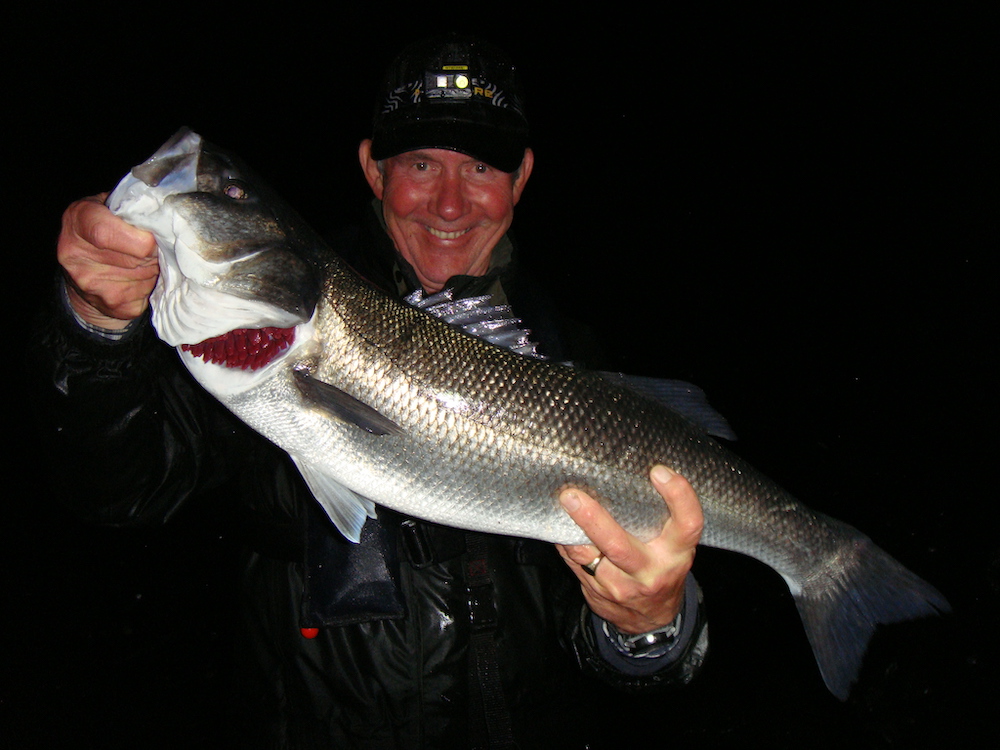
Getting bigger

Going by the number of 60cm+ fish that  were around in 2019, I was expecting to see decent numbers of 65+cm fish last year, the fish having put on an extra year’s growth. I was also hoping there might be a realistic chance of a double, given that the 70cm fish which seemed to be cropping up regularly in catch reports later in the year would have grown to mid 70’s+

But Simon Toms, Cornish Federation of Sea Anglers fish recorder, notes that only 7 bass over 7lb were recorded from the shore, with the biggest just over 8lb. This despite a lot of anglers fishing for bass in good conditions (before the weather deteriorated in the autumn), who also noted the lack of larger bass. On the bright side, Simon notes that there were good numbers of 3 and 4lbers around.

Natural causes

It’s important to take a balanced view in these situations, and consider what else might be contributing to the picture. Are natural causes also playing a part?

The hoped-for boost in catches from migrating fish in late Oct, and again in mid Dec, didn’t materialise. There were reports of large shoals of bass further east in early December, and commercials seemed to be getting lots of bass in nets in Cornwall around this time, but this didn’t translate into improved catches for anglers. These bass were often stuffed with pilchards.

Bass will follow pilchards, and if you can intercept these baitfish, you could have a bass bonanza. Mostly though, the pilchards and the bass will be out of the shore angler’s reach, except perhaps when there’s a good onshore blow to push the pilchards in. Even boat anglers will struggle, trying to compete with all that natural bait, and with bass completely full, and not able to feed again until they have digested their last meal.

Pilchards (Sardina pilchardus), caught inshore during autumn 2020. Are the shoals off Cornwall increasing each year?
Photo: Stuart Martinez
A portly 55cm late November bass. This one looked like it had been pigging out on pilchards.

Simon Toms comments on a serious lack of mackerel close inshore from July to November last year, and thinks there is a link between this and the fewer big bass we saw. The regular occurrence of tuna close inshore may have had a bearing on both the presence of mackerel, and of  bass – either indirectly, by pushing their food source further out, or directly by the need to avoid these large predators.

A measure of success

With my diary review in mind, it’s interesting to think about what constitutes successful bass fishing to each of us. I don’t get too hung up on numbers of fish (unless of course we’re talking big ones!), but rather I think in terms of the number of successful sessions I’ve had in any given season. These might include sessions where I’ve caught half a dozen 2-3lbers, or at least one fish over 4lb. Some will think this is a pretty meagre measure of success, and my sights have lowered over the years as the quality of bass fishing has declined. Even by this yardstick my bass fishing in 2020 was poor, with only 9 successful trips. Red-letter days, with the landing of an 8lb+ fish, are becoming as rare as rocking horse poo!

But success isn’t just about results. If I happen to hit the mother lode, catching numbers of fish, in quick succession, rather than cash in, I use the opportunity to prove a new lure or bait. This usually results in fewer fish caught than if I had stuck with whatever I was using. But it can also lead to gaining confidence (or not) in new things, thereby potentially enhancing your overall fishing success and pleasure, and avoiding wasted time on things that don’t work for you.
Other measures of success include discovering new marks and new methods, or just simply enjoying time spent fishing in beautiful places and inspiring conditions, time which burns itself into your memory. Trying new marks can also result in fruitless sessions and lower catch figures, but this is a price I’m prepared to pay – up to a point.

Talking of measures of success, why not pick up one of the new BASS competition tapes?

Another year, another lure

I don’t think I could be described as a ‘tackle tart’,  but I do have a penchant for lures. It’s not like I’m addicted or anything (well maybe slightly, to one or two), but I love the search for the perfect lure that casts well, can be fished through anything or in any situation, is reasonably priced and catches huge bass every cast just using a straight retrieve. OK, there’s no such lure (if there is please let me know!), so I’m continually looking at different types of lures for bass fishing, hoping to discover (or rediscover) ones which will improve my results, and are best suited to the varied and changing way I fish.

I almost feel guilty, and a little fickle, in saying that my ‘go to’ soft plastic, the good old DoLive faced stiff competition from the Swimsenko in 2020. I started using this again, after reading a post on Mike Ladle’s blog; a fish on the very first cast and I was hooked, never mind the fish! I noticed that the paddle tail on this lure seemed to gee the fish up on the very small tides, when the DoLive seemed to struggle, so it’s now first choice at such times.

I’m generally late coming to the party in relation to lures. The SF125 is a case in point. I took pity on the one which had been languishing in the fishing drawer since my Ireland days. I  was repaid with almost instant success when I took it for a swim back in the summer, and it’s become a regular when fishing in roughish conditions in daylight – single barbless hooks and all. Likewise the classic Chug Bug, now adorned with two big singles, has finally proved its worth for me.

On a more contemporary note, 2020 saw me catching my first fish on the Autowalker 115S, the Dark Sleeper and, with thanks to angling buddy Stuart Martinez,  Mishna eels. Who knows what I’ll discover in 2021; I have a feeling that needlefish lures might make an appearance.

Captain Derek Goodwin MBE

I can’t close without a word about my good friend Derek Goodwin. As readers of my book will know, Derek is something of a legend, an inspiration to us all, for his hard work and dedication to conducting juvenile bass surveys over many years in Cornish estuaries. I was delighted to learn that he had been awarded the MBE for this work. I have been pleased to help Derek since 2013, and I can say that this award is richly deserved. I know that Derek is absolutely delighted, and so pleased that this important work has been recognised in this way.

Derek, making his way upriver to a survey site.

Roll on next season

Well, that’s me done fishing for now – time to hunker down for the rest of the winter I think. Let’s hope this year’s fishing is better than last!

I hope you and your family stay safe, and that things get back to something approaching normality just as soon as possible.

Featured image from Pixabay